
Building Consensus Across Borders: Modern Voting for International Alliances

International alliances bring together member organizations from different countries, cultures, and time zones. While diversity is a strength, it also presents unique challenges for collective decision-making. How do alliances ensure that all voices are heard fairly when members are scattered across continents and working in different languages and time zones? 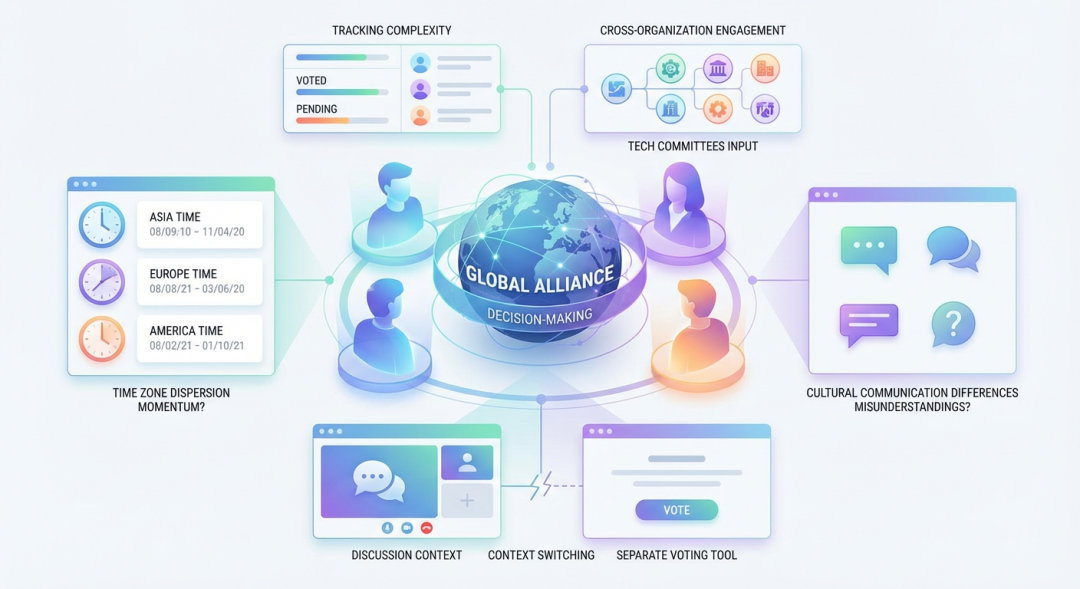 Let’s say there is an international standards alliance with member organizations across Asia, Europe, and North America. When they need to vote on a new technical standard proposal, they face several coordination challenges:
- Time zone fragmentation: Voting periods span multiple business days, making it hard to maintain momentum
- Cultural communication differences: Members express opinions differently, risking misunderstandings in vote rationales
- Tracking complexity: Keeping track of who has voted, who hasn’t, and ensuring all eligible members participate
- Context switching: Discussions happen in meetings, but voting happens in separate tools, breaking the flow
- Cross-organizational participation: Some decisions require input from technical committees that span multiple member organizations
The Challenge: Democratic Decision-Making at Scale
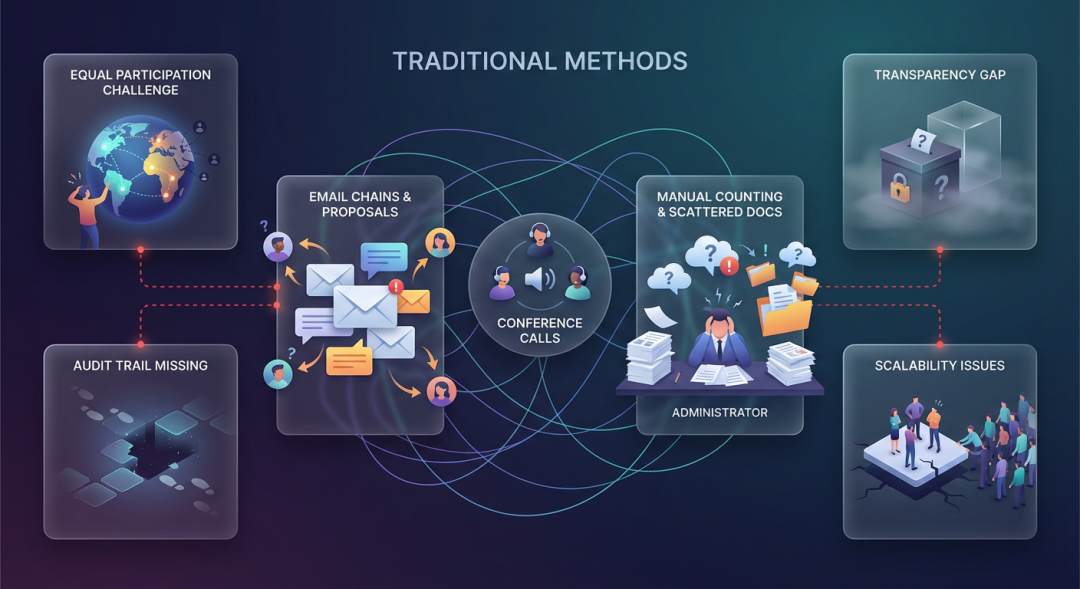
Traditional voting methods for international alliances often rely on:
- Email chains for proposals and discussions
- Separate conference calls for deliberations
- Manual tallying of votes, often done by a single administrator
- Scattered documentation of decisions and rationales
These approaches struggle with:
- Ensuring equal access to decision processes for all members regardless of location
- Maintaining transparency in how votes are collected and recorded
- Providing clear audit trails for future reference
- Scaling as alliance membership grows
Solution: AllianceHub’s Integrated Voting Framework
AllianceHub addresses these challenges by providing a comprehensive voting framework integrated with the broader collaboration ecosystem.
1. Discussion-to-Decision Flow: Seamless Integration

One of AllianceHub’s key strengths is the deep integration of voting functionality within meeting contexts:
- Ballots within meetings: Users can initiate ballots related to agenda topics directly during or after meetings
- Unified workflow: Discussion, deliberation, and voting happen in the same platform context
- Natural progression: Teams move seamlessly from discussing topics to voting on decisions
This eliminates the fragmentation where discussions happen in one tool and voting in another. When an international technical committee finishes discussing a standard proposal, they can immediately initiate a formal vote on adoption—right within the same meeting context.
2. Meeting Topic Management: Structured Input
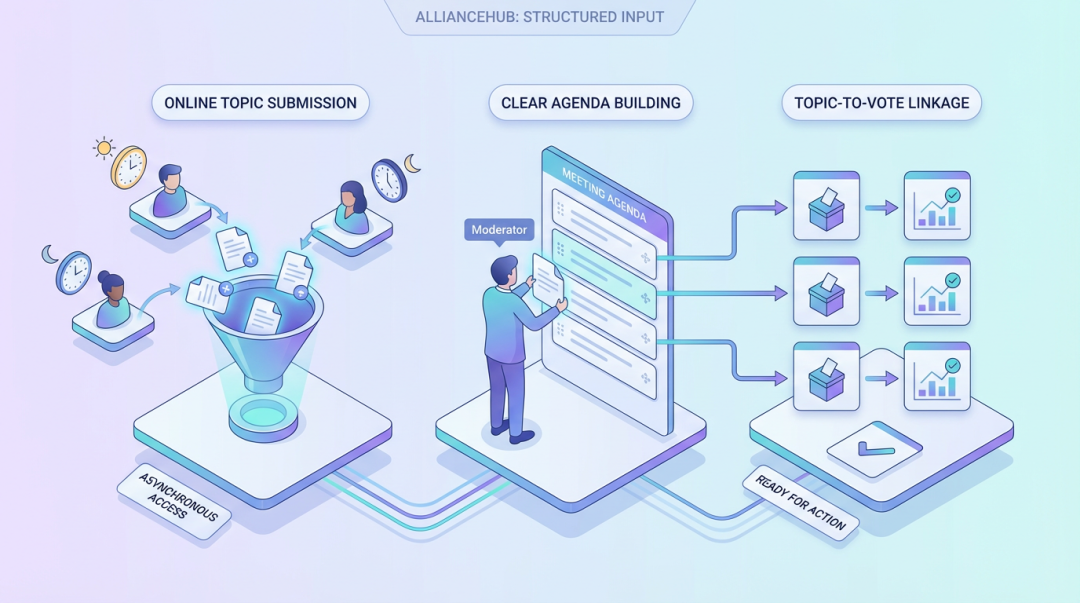
Before voting even begins, AllianceHub supports structured topic submission:
- Online topic submission: Participants can submit meeting topics and proposals online
- Clear agenda building: Meeting organizers efficiently collect discussion topics
- Topic to vote linkage: Topics discussed in meetings can directly inform ballot creation
For international alliances, this ensures that members in different time zones can contribute to the agenda without having to attend synchronous meetings. They can submit topics asynchronously, knowing their input will be formally considered.
3. Cross-Group Voting: Flexible Participation

International alliances often have complex organizational structures with specialized committees, working groups, and regional chapters. AllianceHub supports flexible voting across these structures:
- Cross-group ballot participation: When initiating ballots, organizers can invite external members from other groups
- Breaking silos: Technical experts can participate in relevant votes even if they’re not direct members of the initiating group
- Committee-based voting: Votes can span multiple member organizations without requiring redundant membership structures
This is particularly important for international alliances where expertise may be distributed across different member organizations. A security review vote might require participation from security experts across multiple companies, even if they don’t all belong to the same formal group.
4. Transparent Voting Process: Clear Progress Tracking
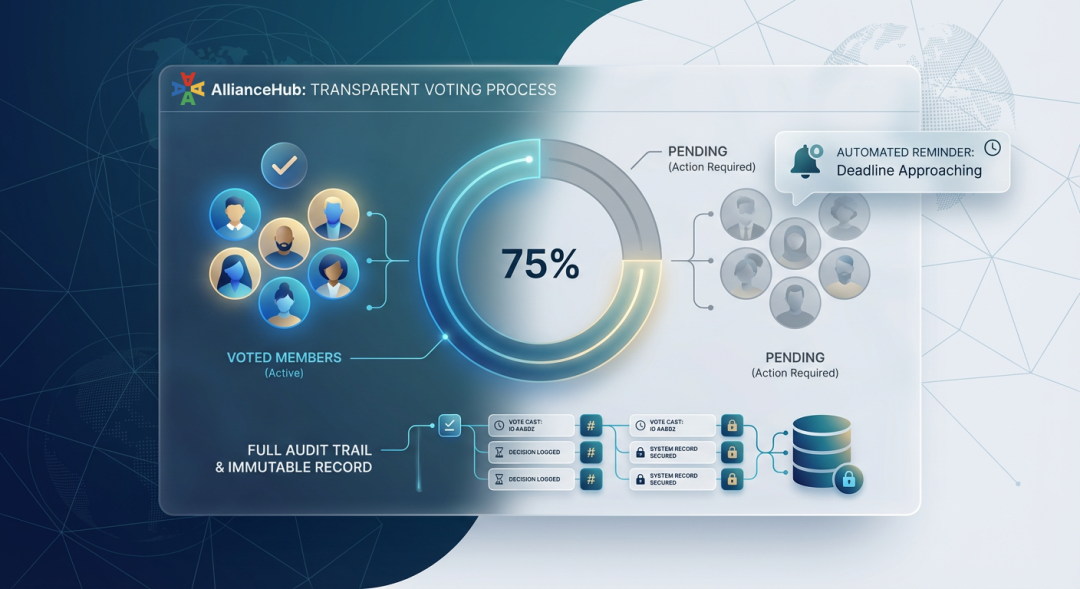
AllianceHub provides visibility into voting progress that builds trust in the process:
- Voter status visibility: Ballot details show “Members Who Have Not Voted,” making progress visible at a glance
- Automatic notifications: Members receive reminders to vote before deadlines
- Complete audit trails: All votes and decisions are systematically recorded for future reference
For international alliances, this transparency is crucial for maintaining confidence in the governance process. Members can verify that voting is proceeding fairly and that all eligible participants have had equal opportunity to participate.
5. Mobile Voting: Participation Without Boundaries
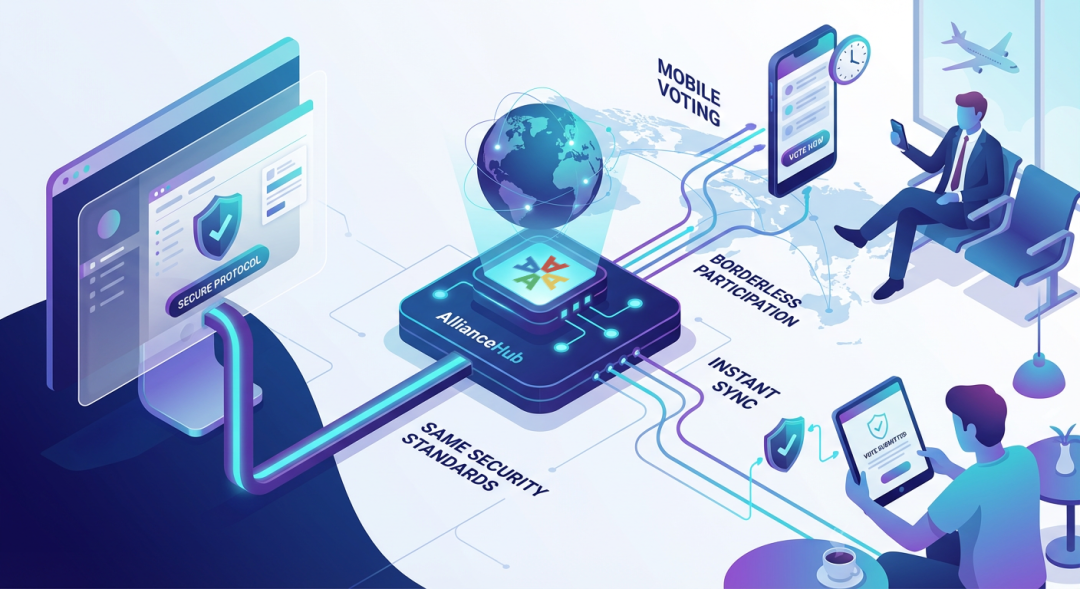
With AllianceHub’s mobile support, voting becomes truly borderless:
- Instant participation: Members can respond to ballots on mobile devices without waiting for desktop access
- Same standards, any device: Mobile voting maintains the same security and validation standards as desktop
- Deadline responsiveness: Members can vote on critical decisions even when traveling or away from their offices
This eliminates location as a barrier to participation. A member organization executive can vote on a strategic alliance decision while traveling between international meetings—ensuring their voice is heard regardless of physical location.
6. Role-Based Permission Control: Structured Governance
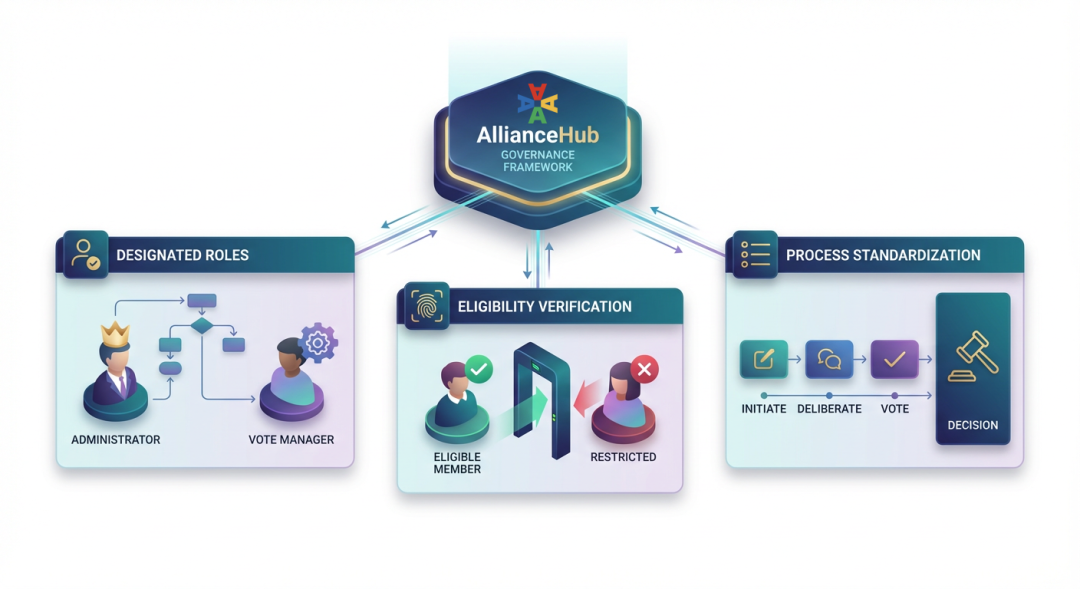
International alliances require clear governance for who can initiate votes and who can participate. AllianceHub provides role-based access control:
- Designated voting roles: Specific administrators can manage voting processes
- Eligibility verification: System ensures only eligible members can vote on specific ballots
- Process standardization: Voting follows consistent procedures across all alliance activities
This governance framework ensures that voting processes are conducted according to alliance rules and that decisions carry proper authority.
7. Integrated Personal Management: Your Voting History
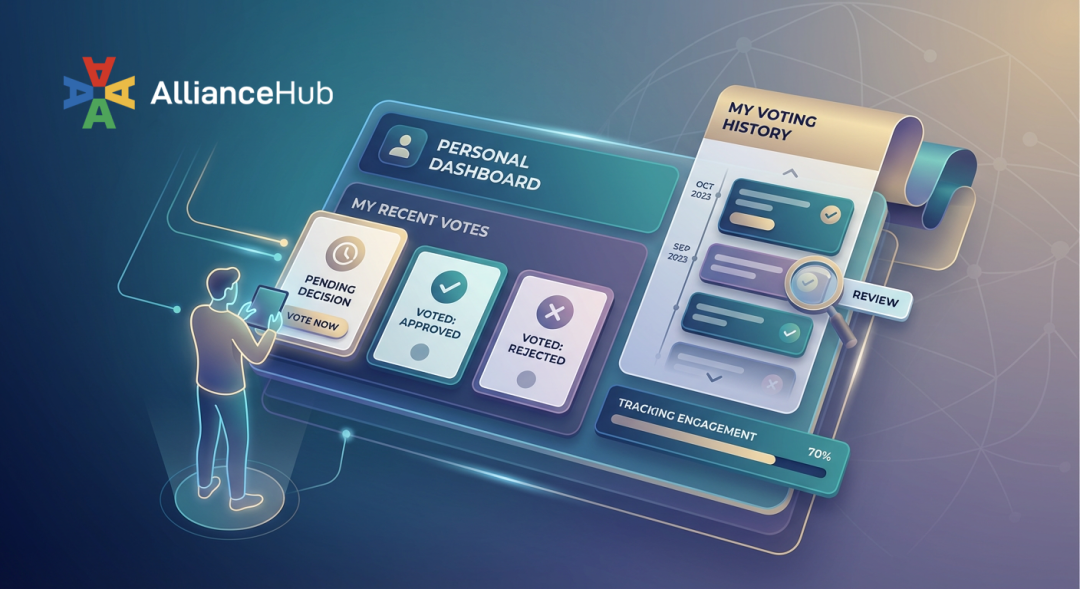
Individual members benefit from centralized voting management:
- “My Recent Ballots”: Dashboard shows recent voting activities for quick access to pending decisions
- “My Ballots” in Personal Center: Complete history of all ballots initiated or participated in
- Easy retrospection: Members can review their past votes and decisions for continuity
This personalization helps alliance members stay engaged with governance processes by making their participation easily accessible and trackable.
Traditional vs. AllianceHub: The Impact
| Aspect | Traditional Voting | With AllianceHub |
|---|---|---|
| Proposal submission | Email threads, scattered | Online topic submission, structured agendas |
| Discussion to voting | Separate tools, fragmented flow | Integrated within meetings, seamless progression |
| Eligibility tracking | Manual spreadsheet tracking | Automatic status visibility and notifications |
| Cross-organization participation | Requires multiple coordinations | Cross-group invitation, flexible membership |
| Location barriers | Must be present at specific times | Mobile voting, participation from anywhere |
| Audit trails | Partial documentation, difficult to retrieve | Complete systematic recording |
| Process transparency | Unclear who voted and when | Visible progress, voter status at a glance |
Key Benefits for International Alliances
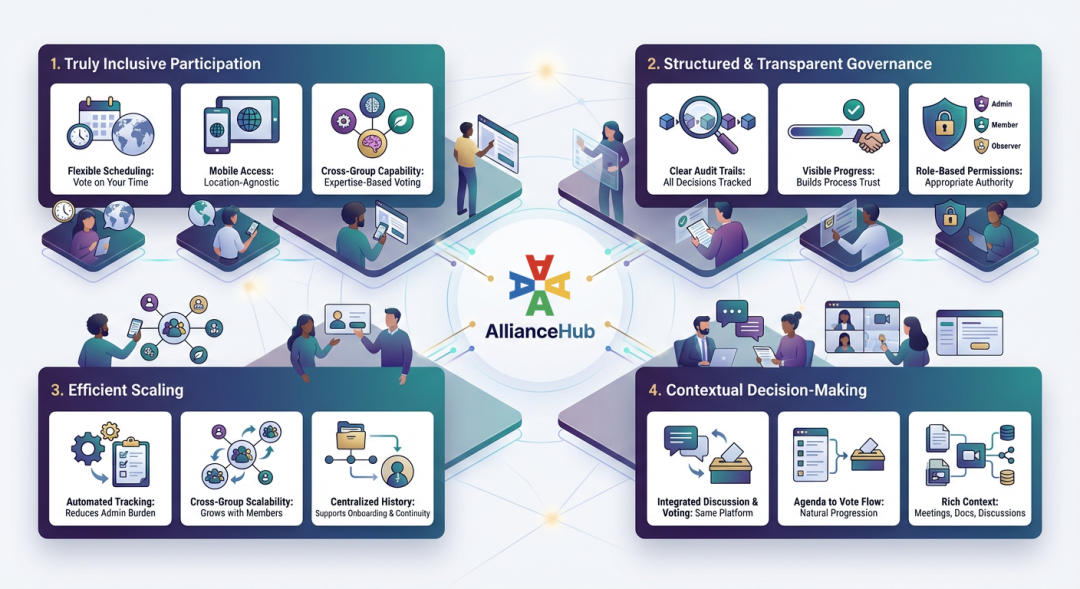 1. Truly Inclusive Participation
- Members vote on their own schedule within voting windows, not on a single call time
- Mobile support ensures no location barriers to participation
- Cross-group capability allows expertise-based voting regardless of organizational boundaries
2. Structured and Transparent Governance
- Clear audit trails for all decisions
- Visible voting progress builds process trust
- Role-based permissions ensure proper authority for voting processes
3. Efficient Scaling
- Automated tracking reduces administrative burden
- Cross-group voting scales as alliance membership grows
- Centralized voting history supports member onboarding and continuity
4. Contextual Decision-Making
- Discussion and voting integrated in the same platform
- Topics flow naturally from agenda discussion to formal voting
- Rich context around decisions (linked meetings, materials, discussions)
Building Trust Through Process
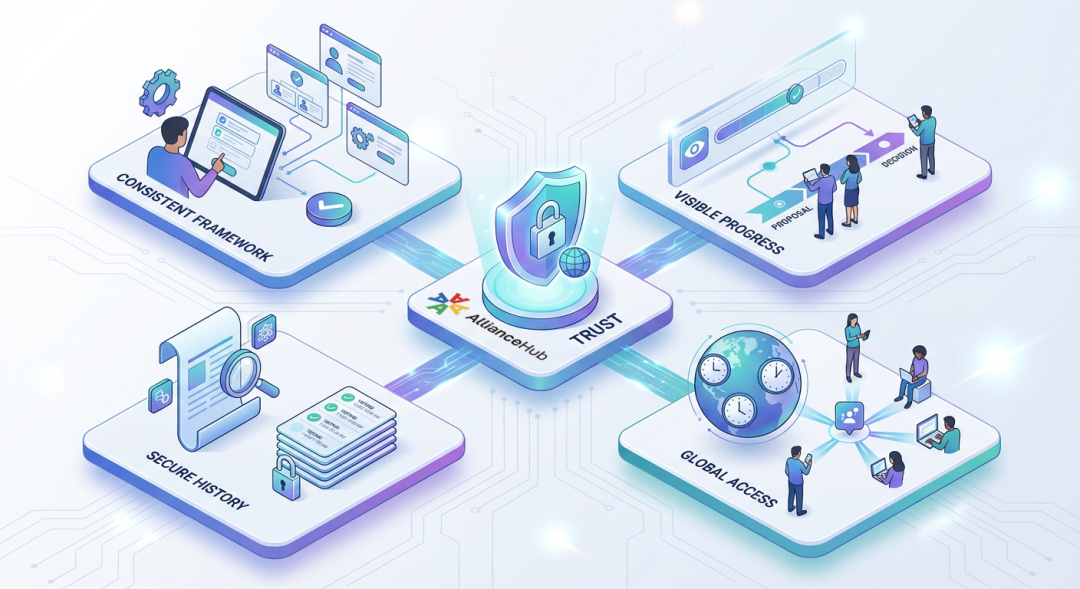
International alliances rely on trust—trust that processes are fair, that all voices are heard, and that decisions are made properly. AllianceHub strengthens this trust by providing:
- Procedural consistency: Same voting framework across all alliance activities
- Visibility into process: Members can track progress and verify participation
- Recorded governance: Complete history of decisions for transparency and accountability
- Flexible participation: Voting accommodates the geographic and temporal diversity of international membership
Conclusion
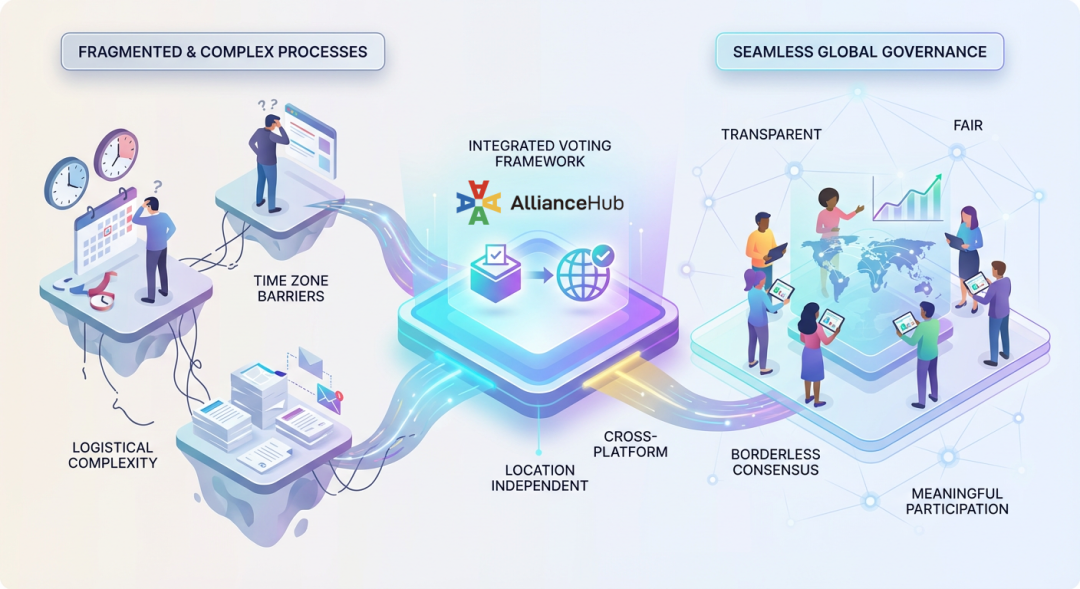
Modern international alliances need modern decision-making tools that respect geographic diversity while ensuring fair, transparent governance. AllianceHub provides exactly this: an integrated voting framework that makes participation accessible regardless of location, time zone, or organizational affiliation.
By integrating voting with the broader collaboration ecosystem, AllianceHub transforms decision-making from a fragmented, logistically complex process into a seamless, transparent, and truly international experience. The result is alliances where all members can participate meaningfully in governance—building consensus across borders, not in spite of them.