
From Informal Chats to Structured Dialogue: Inside AllianceHub's New Discussion Module
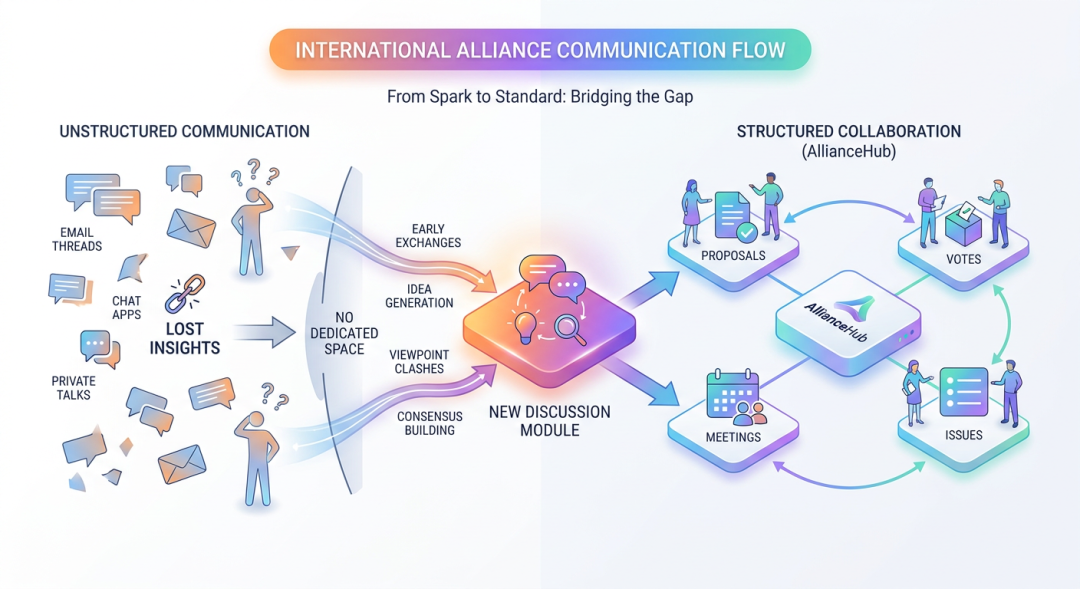
International alliances run on communication. But not all communication carries the same weight. A formal ballot to adopt a new standard requires rigorous procedure. A proposal advancing through review stages follows a defined workflow. Yet much of what drives alliances forward happens before any of that begins—in the early exchanges where ideas surface, perspectives clash, and rough consensus takes shape.
Until now, AllianceHub has excelled at the structured end of collaboration: proposals, ballots, meetings, topic calls. But where do members go when they need to think out loud, debate an approach, or ask a quick question before committing to a formal process? They scatter to email threads, chat apps, and side conversations—tools that were never designed for alliance-scale collaboration.
Let’s say there was an international standards alliance with a technical committee preparing to draft a new specification. Before writing a formal proposal, members needed to align on scope, debate technical trade-offs, and clarify open questions. Without a dedicated space for this kind of exchange, discussions fragmented across email and messaging platforms. Key insights got buried in long threads. New members couldn’t find earlier context. Nothing was traceable.
The new Discussion module in AllianceHub V3.4 was built to solve exactly this problem.
The Gap Between Chat and Governance
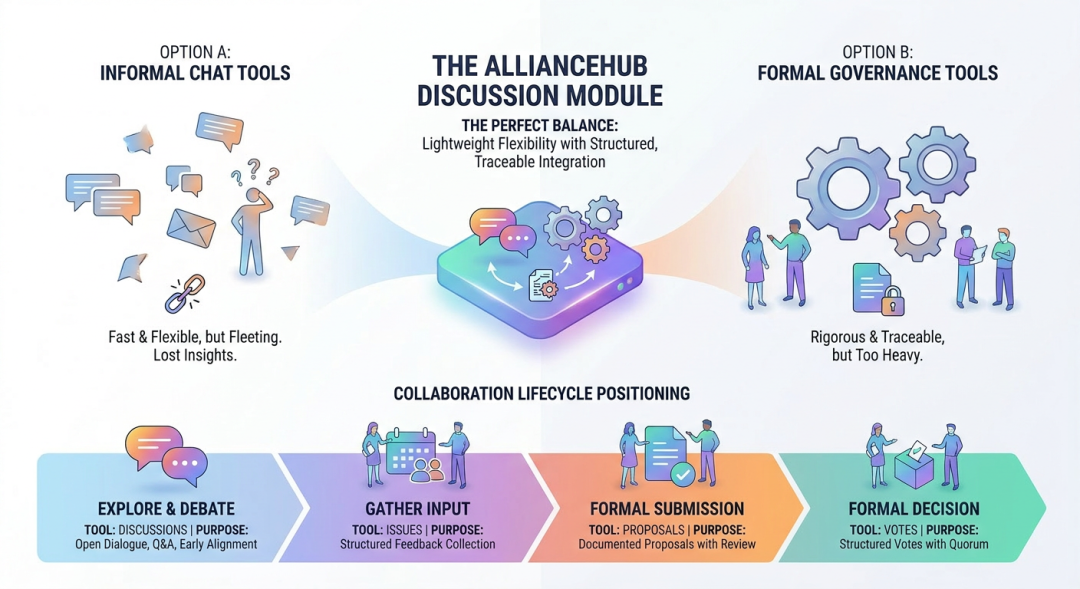 Most collaboration platforms force alliances into one of two extremes:
Option A: Informal chat tools — fast and flexible, but conversations disappear, search is unreliable, and nothing connects to the alliance’s governance workflows.
Option B: Formal governance tools — rigorous and traceable, but too heavy for the exploratory conversations that precede decisions.
The Discussion module occupies the space between these extremes. It provides the lightweight flexibility of a conversation tool with the structure, traceability, and integration that alliance collaboration demands.
Where Discussion fits in the collaboration lifecycle:
| Stage | Tool | Purpose |
|---|---|---|
| Explore & debate | Discussion | Open dialogue, questions, early alignment |
| Gather input | Topic Calls | Structured collection of member feedback |
| Formal submission | Proposals | Documented proposals with review workflows |
| Formal decision | Ballots | Structured voting with quorum enforcement |
Discussion is where ideas begin. Topic Calls, Proposals, and Ballots are where they mature into decisions.
Building the Group’s Collaboration Hub
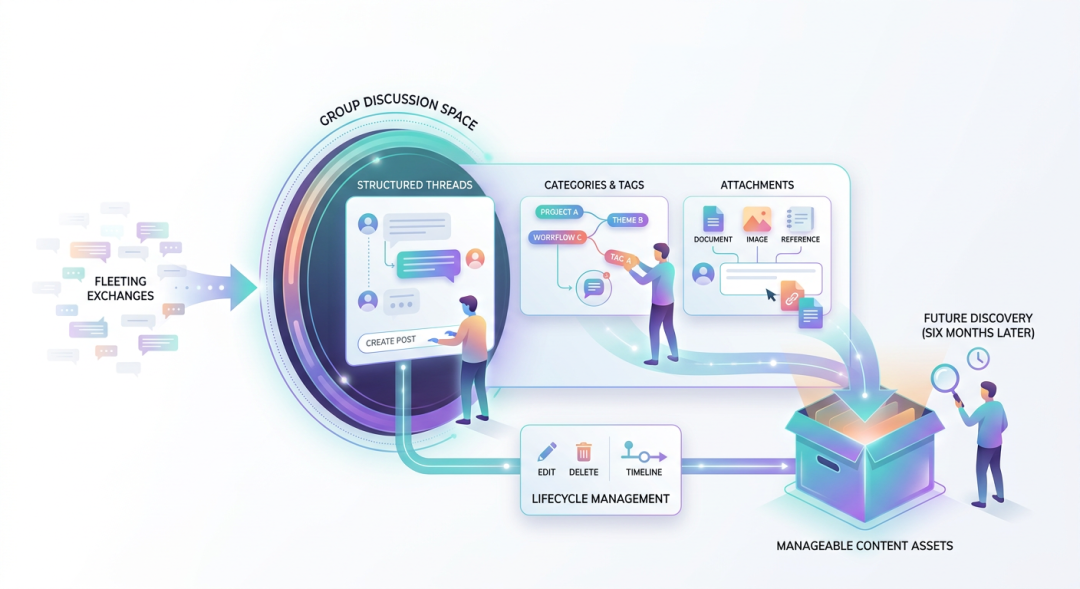 The Discussion module is designed as a group-level collaboration center. Each group within an alliance gets its own discussion space, keeping conversations contextual and relevant.
Core capabilities:
- Posts and comments — Members create discussion posts around specific topics and engage through a structured comment system
- Categories and tags — Organize discussions by theme, project, or any classification that fits the group’s workflow
- Attachments — Share documents, images, and reference materials directly within discussion context
- Full lifecycle management — Create, edit, and delete posts as needs evolve
This transforms discussions from fleeting exchanges into managed, discoverable content assets. When a new member joins a group six months later, they can find and read through earlier conversations rather than asking the same questions again.
Two-Level Comments: Depth Without Chaos
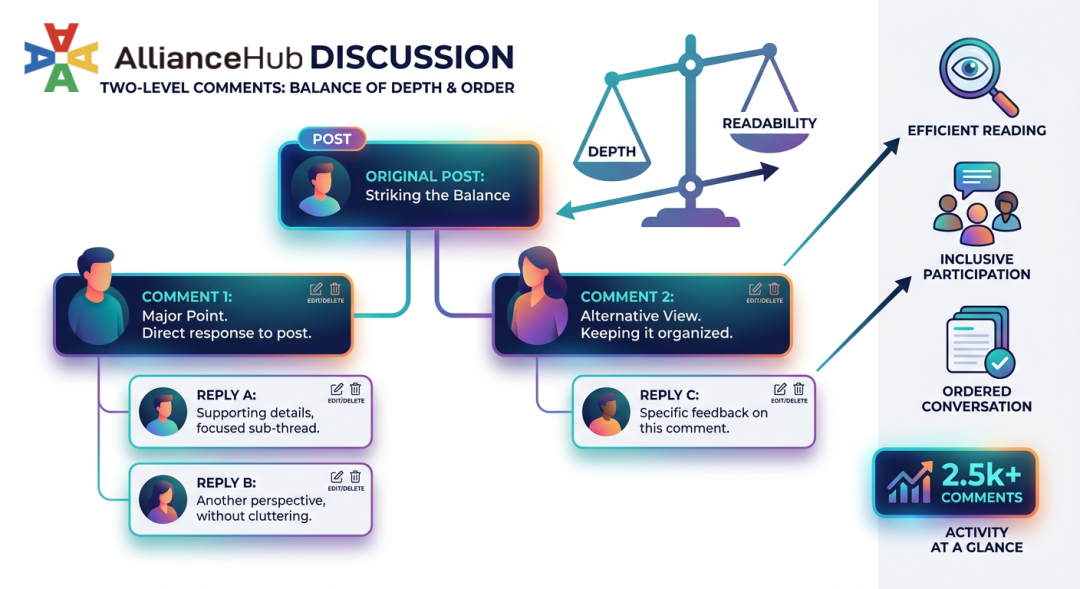 One of the trickiest design challenges in discussion tools is balancing depth with readability. Flat comment streams become unreadable in active discussions. Deeply nested threads make it hard to follow the overall conversation.
The Discussion module uses a two-level comment structure—comments and replies—to strike this balance:
- Comments respond directly to the original post, forming the primary discussion
- Replies respond to specific comments, enabling focused sub-conversations without fragmenting the thread
Benefits of the two-level approach:
- Conversations stay organized — related points cluster together naturally
- Reading is efficient — members scan comments for the main discussion, dive into replies for detail
- Participation is inclusive — the structure encourages response rather than creating intimidating deep threads
- Activity is visible — automatic comment counts show how active each discussion is at a glance
Comments and replies both support editing and deleting, giving members control over their contributions without requiring moderator intervention for simple corrections.
Pinning and Closing: Managing Discussion Flow
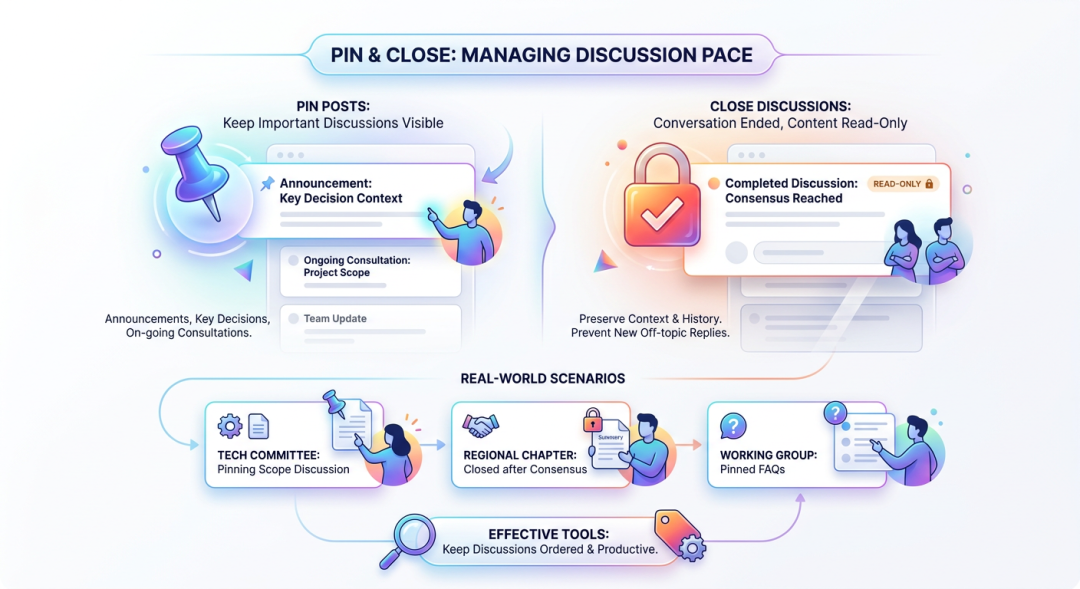
Not all discussions carry the same urgency or lifecycle. The Discussion module provides tools to manage how conversations evolve:
Pinned posts keep important discussions at the top of the list. When a group needs members to see an announcement, a key decision context, or an active consultation, pinning ensures visibility without repeated bumping.
Closed discussions signal that a conversation has reached its natural conclusion. Members can still read the content—preserving context and institutional memory—but no new comments can be added. This prevents stale threads from accumulating new, off-topic responses while keeping the historical record intact.
Practical scenarios:
- A technical committee pins a discussion about specification scope while drafting is underway
- A regional chapter closes a discussion after reaching consensus, with a summary comment capturing the outcome
- A working group pins a FAQ discussion to help new members onboard quickly
Combined with categories and tags, pinning and closing give group administrators simple but effective tools to keep discussions organized and productive.
@Mentions and Notifications: Reaching the Right People
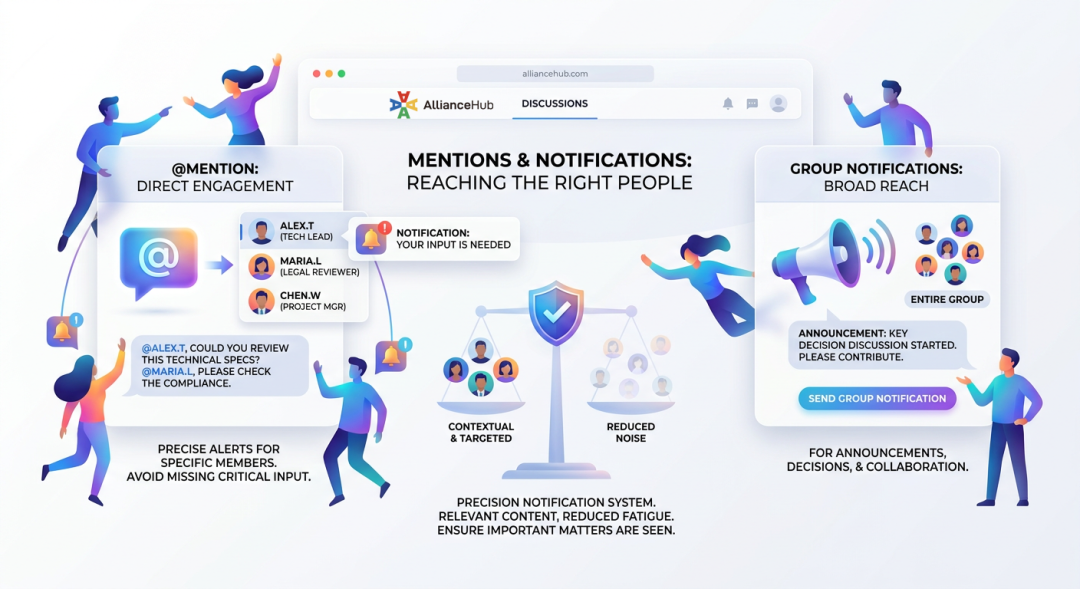
In a busy alliance, the biggest communication risk isn’t miscommunication—it’s missed communication. Important messages get lost in the noise. People who should weigh in never see the discussion. Response times stretch because members don’t know their input is needed.
The Discussion module addresses this with a targeted notification system:
@mentions allow members to directly reference and alert specific group members within posts and comments. Need the technical lead’s opinion? Tag them. Want the legal reviewer to see a particular question? Mention them directly.
Notification triggers ensure that key activities reach the right people automatically:
| Action | Who Gets Notified |
|---|---|
| New discussion created | Group members |
| Comment or reply added | Discussion participants |
| Member @mentioned | The mentioned member |
| Discussion closed | Discussion participants |
| Discussion deleted | Group administrators |
Members can also send notifications to the entire group when broad awareness is needed—announcing a critical discussion, sharing a decision context, or launching a collaborative brainstorm.
This precision matters. Rather than broadcasting every activity to everyone, notifications are contextual and targeted. Members see what’s relevant to them, reducing notification fatigue while ensuring nothing important goes unnoticed.
Permissions and Audit: Secure and Accountable
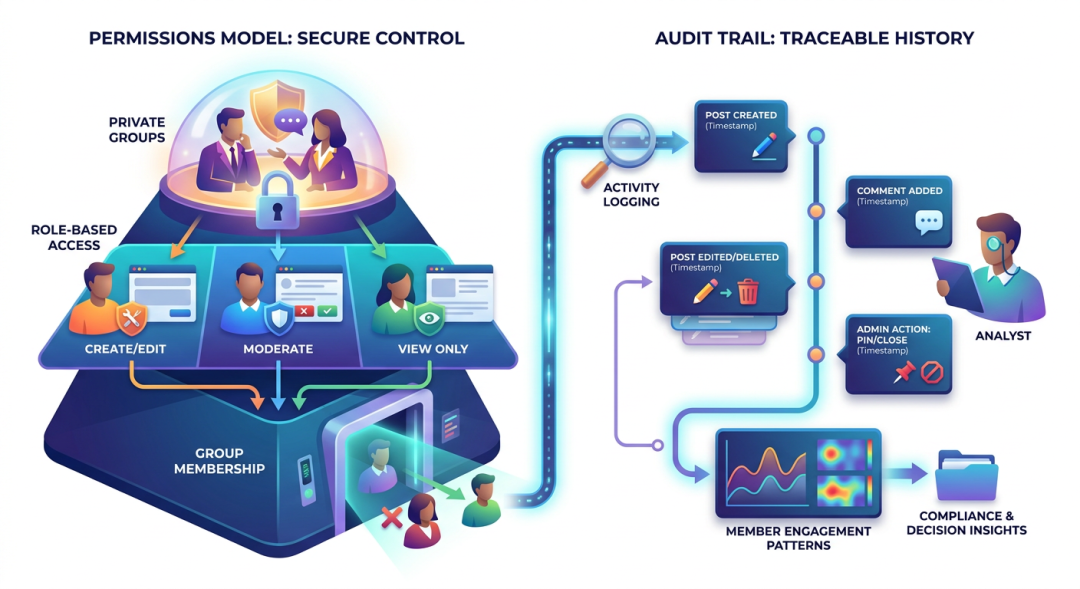
Alliance collaboration often involves sensitive topics—strategic direction, proprietary technical discussions, personnel matters. The Discussion module inherits AllianceHub’s permission architecture to ensure discussions remain appropriately controlled.
Permission model:
- Group membership determines who can view and participate in discussions
- Role-based controls distinguish between who can create, moderate, and manage discussions
- Private groups ensure confidential discussions remain visible only to authorized members
This means discussions within the executive committee stay within the executive committee. Technical working group debates remain accessible to group members. The same granular access control that governs proposals, ballots, and documents extends naturally to discussions.
Audit trail:
Every significant action in the Discussion module is logged:
- Post creation, edits, and deletions
- Comment activity
- Pinning and closing operations
- Member engagement patterns
This auditability serves multiple purposes. Administrators can review engagement to understand which topics generate the most discussion. Compliance teams can trace how decisions were influenced by earlier conversations. Group leaders can identify discussions that may need formal follow-up through proposals or ballots.
Completing the Collaboration Spectrum
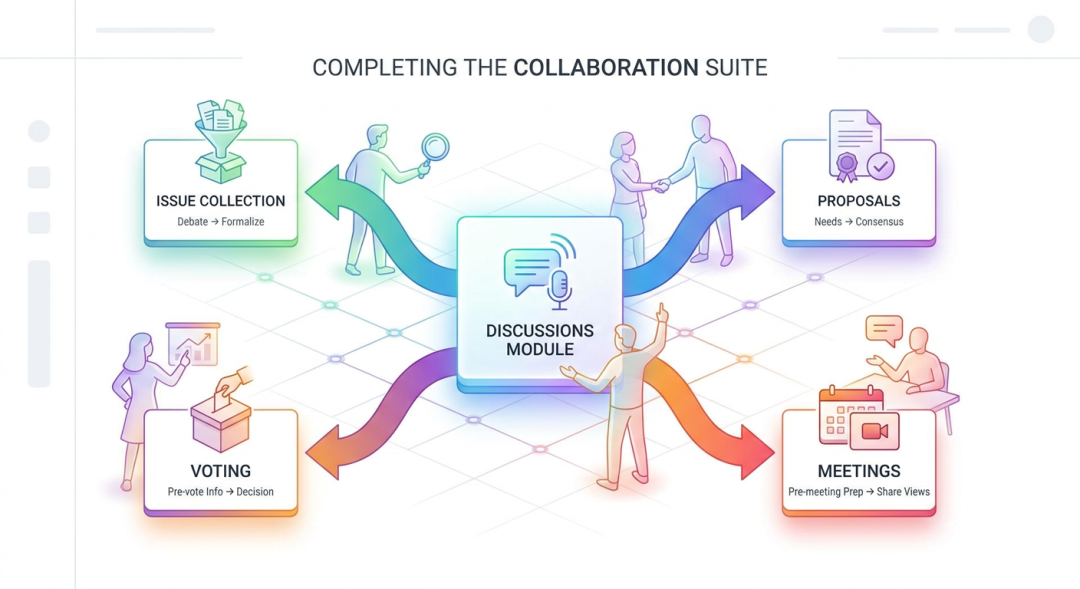
Perhaps the most important aspect of the Discussion module is how it completes AllianceHub’s collaboration toolkit. Before V3.4, alliances had powerful tools for structured workflows but no dedicated space for the exploratory conversations that precede them.
How Discussion connects to existing modules:
Discussion → Topic Calls: A group debates potential topics in Discussion, then formalizes the most promising ones through Topic Calls when they’re ready for structured input collection.
Discussion → Proposals: Technical discussions surface requirements and trade-offs. When alignment is sufficient, a formal Proposal captures the agreed direction for official review.
Discussion → Ballots: Pre-vote discussions help members understand ballot items before casting their votes, leading to more informed participation and higher-quality outcomes.
Discussion → Meetings: Discussion posts serve as pre-meeting preparation, allowing members to raise questions and share perspectives before the session begins.
This isn’t about replacing any existing module. It’s about filling the collaborative space where ideas first take shape—before they’re ready for the structure of formal governance tools.
Why This Matters for International Alliances
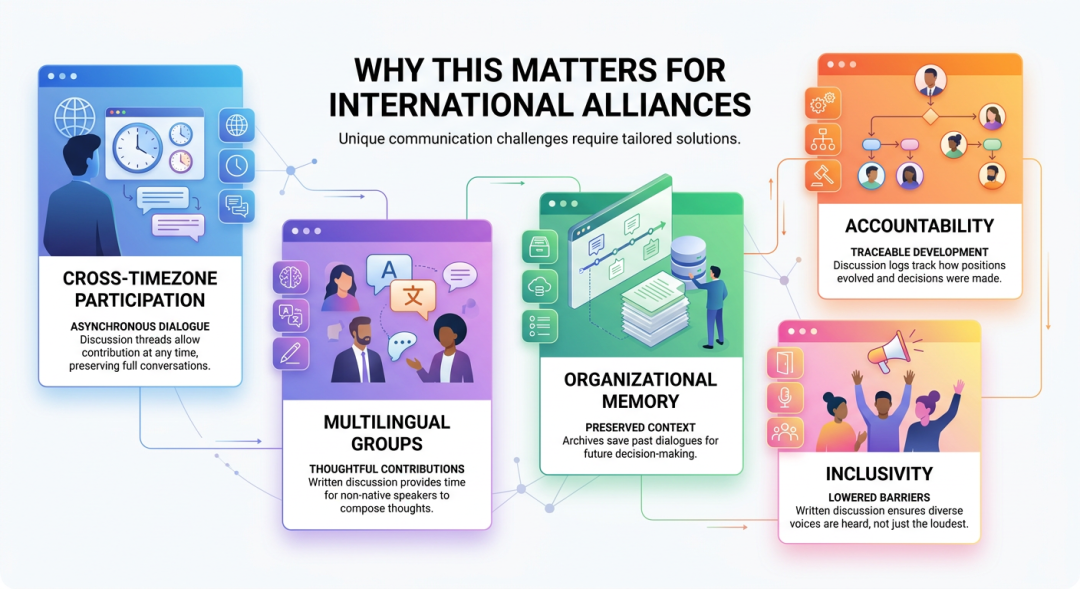
International alliances face unique communication challenges that generic tools don’t solve:
Cross-timezone participation. When members span continents, synchronous communication is rarely possible. Discussion posts and comments let members contribute on their own schedules while keeping the full conversation accessible.
Multilingual groups. Written discussions give non-native speakers time to compose thoughtful contributions rather than struggling in real-time conversations.
Organizational memory. Alliance work spans years. Decisions made today build on conversations from months or years ago. Discussion archives preserve this context for future members.
Accountability. In governance contexts, being able to trace how a position developed—who raised what concern, what alternatives were considered, why a direction was chosen—matters. Discussion logs provide this traceability.
Inclusivity. Not everyone feels comfortable speaking up in meetings. Written discussions lower the barrier to participation, ensuring diverse perspectives are heard.
Getting Started with the Discussion Module
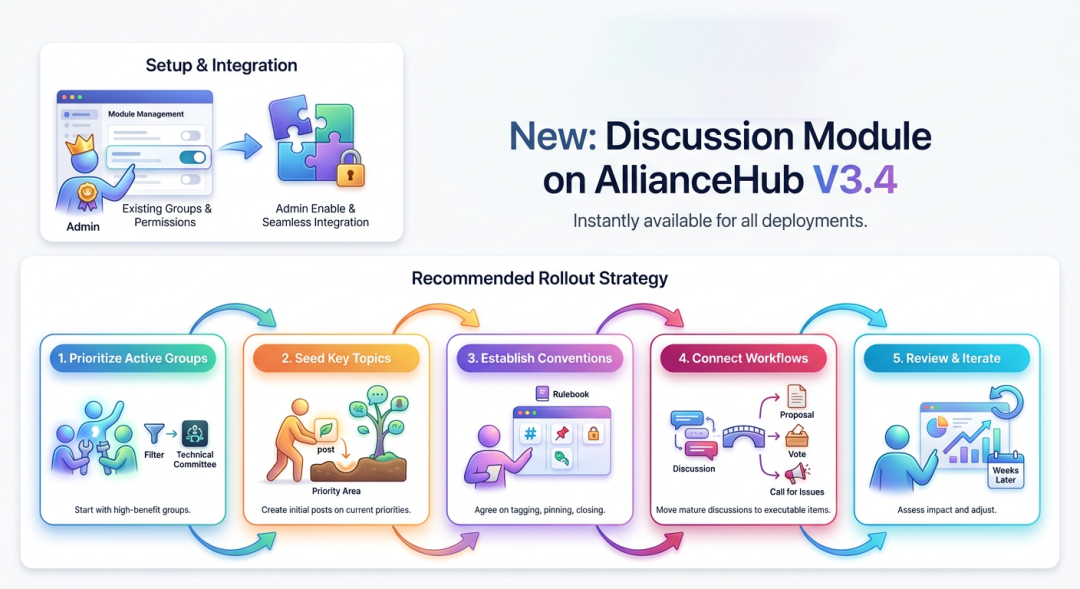
The Discussion module is available immediately for all AllianceHub V3.4 deployments. Group administrators can enable it through Module Management, and it integrates seamlessly with existing group structures and permissions.
Recommended rollout approach:
- Enable for active groups first — Start with technical committees and working groups that have the most to gain from structured dialogue
- Seed discussions with key topics — Create initial posts around current priorities to demonstrate the module’s value
- Establish conventions — Agree on categories, tagging practices, and expectations for pinning and closing discussions
- Connect to workflows — When discussions mature into actionable items, transition them to Topic Calls, Proposals, or Ballots as appropriate
- Review and iterate — After a few weeks, assess what’s working and adjust conventions accordingly
Conclusion
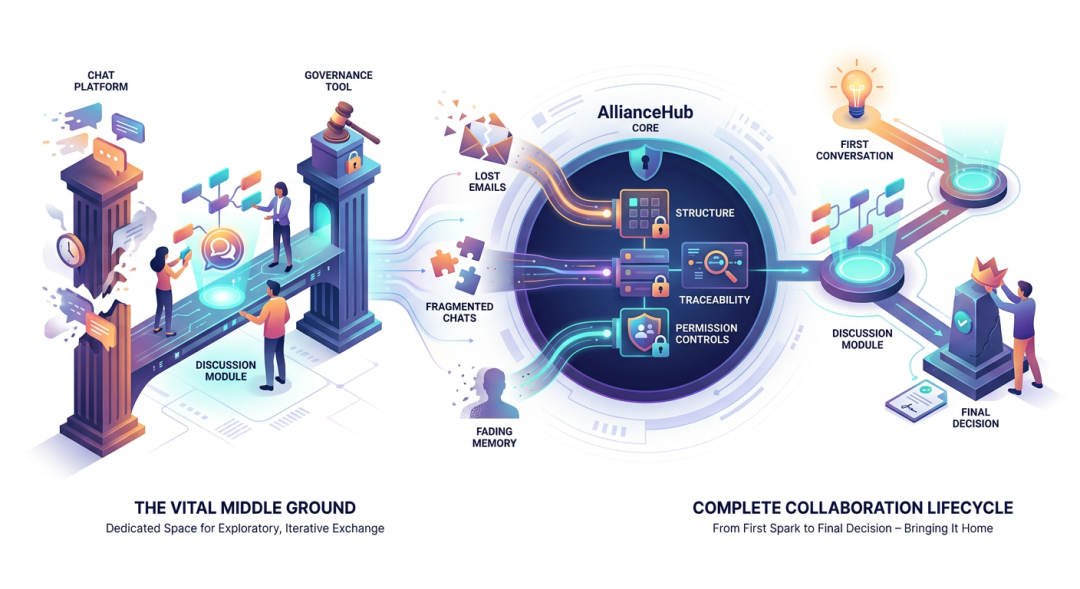 The Discussion module doesn’t try to be a chat platform or a governance tool. It’s something more valuable: a dedicated space for the conversations that happen between informal chat and formal decision-making—the exploratory, debated, iterative exchanges where alliance work truly begins.
By bringing these conversations into AllianceHub, the Discussion module ensures they benefit from the same structure, traceability, and permission controls that make the platform’s governance tools so effective. No more lost email threads. No more fragmented chat history. No more institutional memory fading with member turnover.
For alliances that have been managing their early-stage collaboration outside the platform, the Discussion module brings it home—completing the collaboration lifecycle from first conversation to final decision.