Beyond Email Lists: Why Modern Alliances Choose AllianceHub Over Mailman
Email has been the backbone of organizational communication for decades. Tools like GNU Mailman have served countless communities by enabling broadcast communication through mailing lists—collecting email addresses and distributing messages to groups efficiently. For simple announcements and discussions, email lists work well enough.
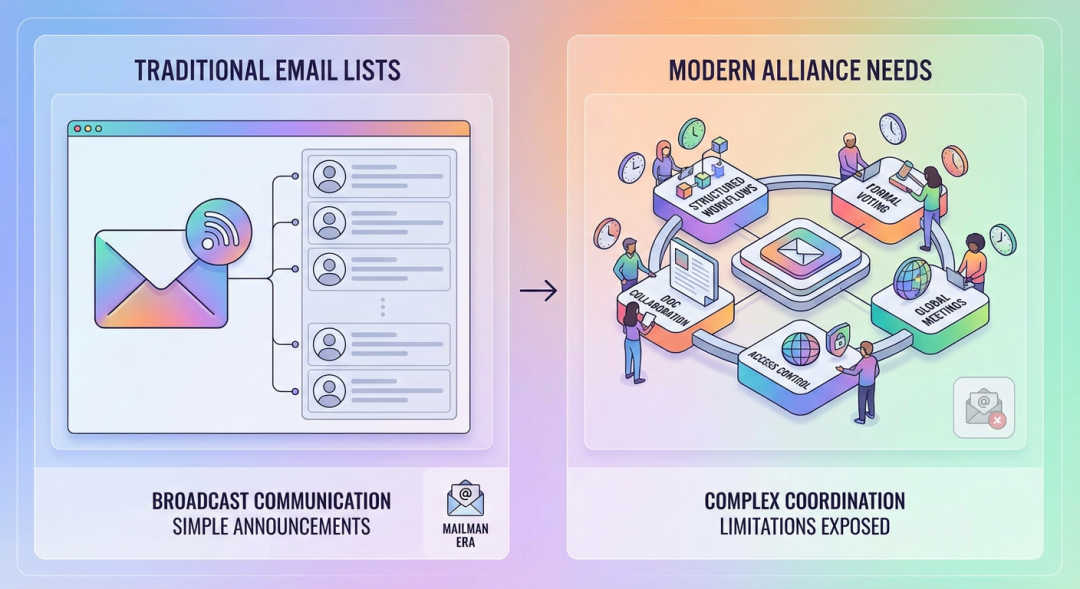
But let’s say there was an international standards alliance managing multiple working groups across different regions. Their coordination needs go far beyond broadcast email. They need structured proposal workflows, formal voting mechanisms, document collaboration, meeting management across time zones, and granular access controls. When this alliance evaluates their tools, Mailman’s limitations become apparent quickly.
What Mailman Does Well (and Where It Stops)
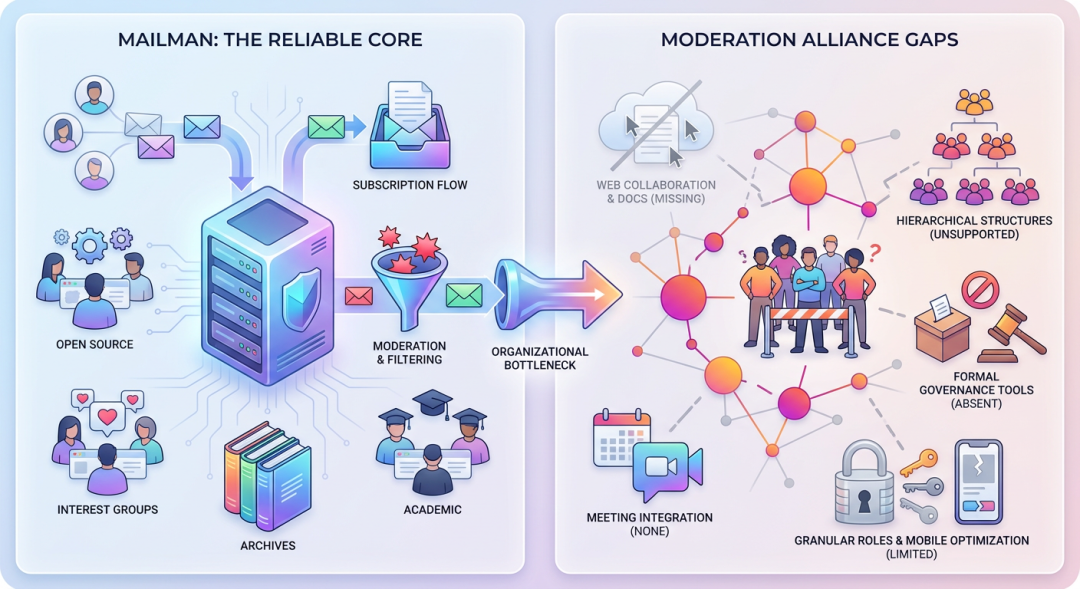
Mailman is a mature, reliable email list manager. It handles subscriptions, moderates messages, archives discussions, and manages bounces. For communities that primarily need discussion lists—open source projects, hobbyist groups, academic communities—Mailman remains a solid choice.
Mailman’s core capabilities include:
- Email-based subscription management
- Message moderation and spam filtering
- Public or private archives
- Basic access controls (who can post, who can subscribe)
- Simple web interface for administration
Where Mailman falls short for modern alliances:
- Email-only interaction: No web-based collaboration, document sharing, or structured workflows
- Flat structure: No support for organizational hierarchies, working groups, or complex membership models
- No formal governance tools: No built-in voting, proposal workflows, or decision tracking
- Limited document management: Attachments are archived but not organized or version-controlled
- No meeting integration: No scheduling, calendar views, or video conferencing integration
- Minimal permission granularity: All-or-nothing access rather than role-based permissions
- No mobile optimization: Web interface is administrative, not designed for mobile participation
For alliances that need more than email discussion, these limitations become organizational bottlenecks.
The AllianceHub Difference: From Communication to Collaboration
AllianceHub is not merely an email list replacement—it’s a comprehensive collaboration platform designed for how modern international alliances actually operate. While Mailman facilitates communication, AllianceHub enables structured collaboration across the full spectrum of alliance activities.
1. From Email Threads to Structured Workflows
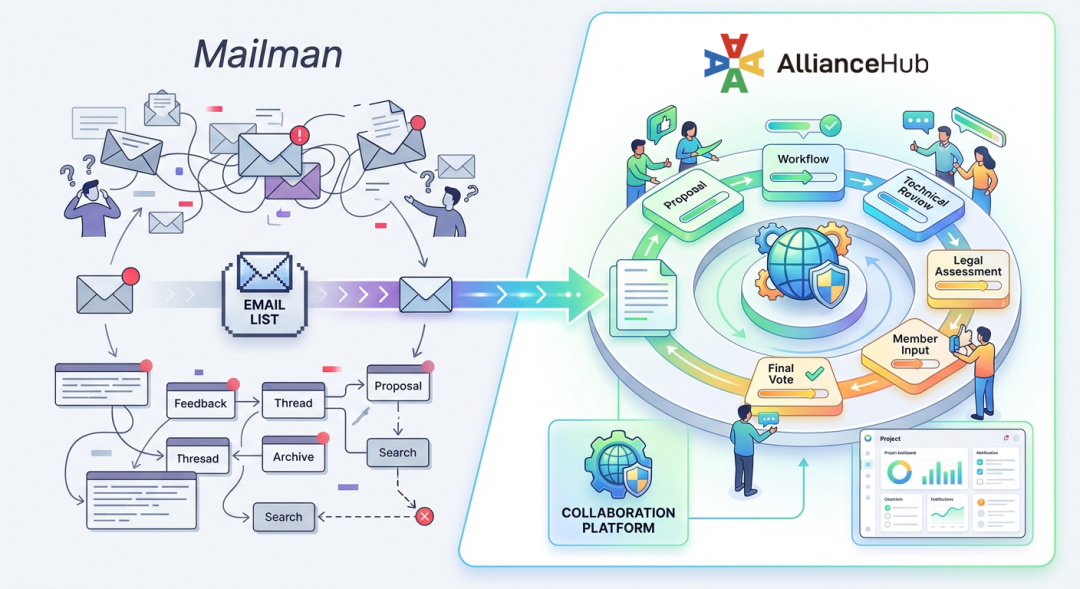
With Mailman: A member organization wants to propose a new standard. They write an email to the technical committee list. The proposal gets mixed into ongoing discussions. Some members reply with feedback—some reply-all, some reply to individual authors. The thread fragments. There’s no formal review process, no stage tracking, no clear path from proposal to decision. Months later, someone asks “whatever happened to that proposal?” Someone searches the archives and tries to reconstruct what occurred.
With AllianceHub: The same member creates a formal proposal within the platform. The system automatically checks for similar existing proposals to prevent duplication.
The proposal enters a configured workflow—perhaps “Technical Review → Legal Assessment → Member Comment → Final Vote.” Stakeholders receive notifications when their input is needed. All feedback is attached to the proposal record. Everyone can see the current stage and what’s next. The proposal advances through governance stages systematically until reaching a formal ballot.
The difference: structured workflow versus chaotic email threads.
2. From Informal Discussion to Formal Decision-Making
With Mailman: The alliance needs to make a decision—perhaps approving a new member or adopting a standard. Someone sends an email asking for opinions. Some members respond. Others don’t. There’s no clear tally of who supports or opposes. Someone tries to call for a vote via email, but which members are eligible to vote? What constitutes a quorum? Did everyone receive the email? The decision lacks procedural rigor and auditability.
With AllianceHub: The alliance initiates a formal ballot. The platform automatically identifies eligible voters based on configured rules. Voters receive notifications and can cast their votes securely—support, oppose, or abstain with comments. Real-time results show participation rates. The system enforces quorum requirements and voting periods. When voting closes, results are automatically tallied with full audit trails. The decision is documented, traceable, and defensible.
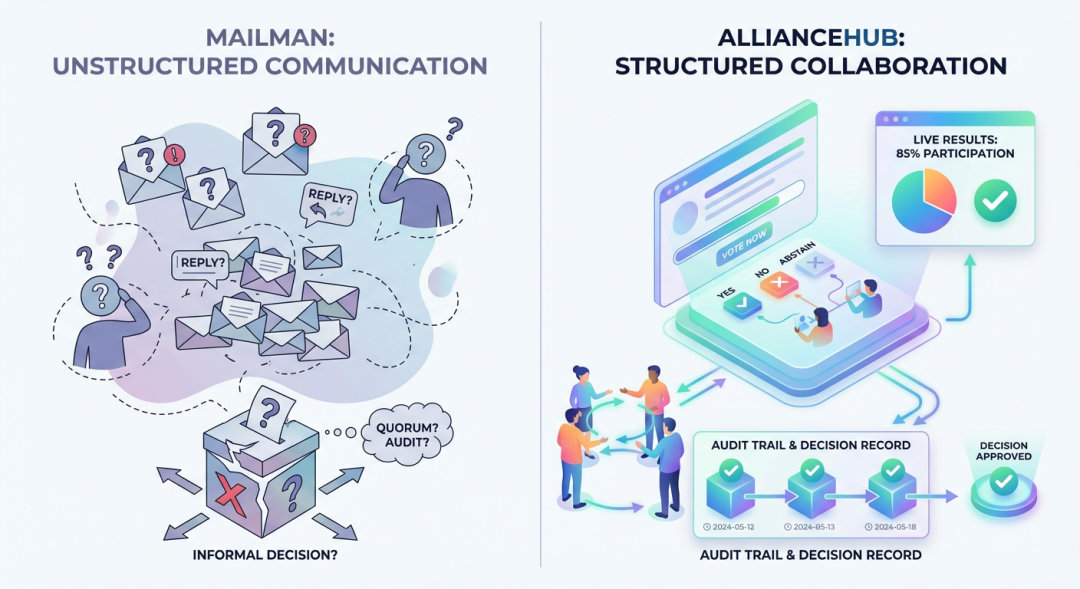
The difference: governed decision-making versus informal polling.
3. From Meeting Chaos to Coordinated Sessions
With Mailman: Coordinating a meeting across multiple time zones requires a flurry of emails proposing times, confirming attendees, sharing agendas, and distributing materials. Someone creates a calendar invite outside the system. Someone else shares documents via a separate file service. Meeting recordings end up wherever the host stores them. Information scatters across platforms. Attendees juggle email threads, calendar invites, and shared folders.
With AllianceHub: Meeting creation happens within the platform. The calendar shows all alliance activities across time zones. Integration with Zoom or Feishu automatically generates meeting links. Agendas are submitted and visible to all attendees. Materials are organized in shared folders with version control. After the meeting, recordings and AI summaries automatically sync to the meeting record. Everything—scheduling, materials, attendance, outcomes—lives in one cohesive system.
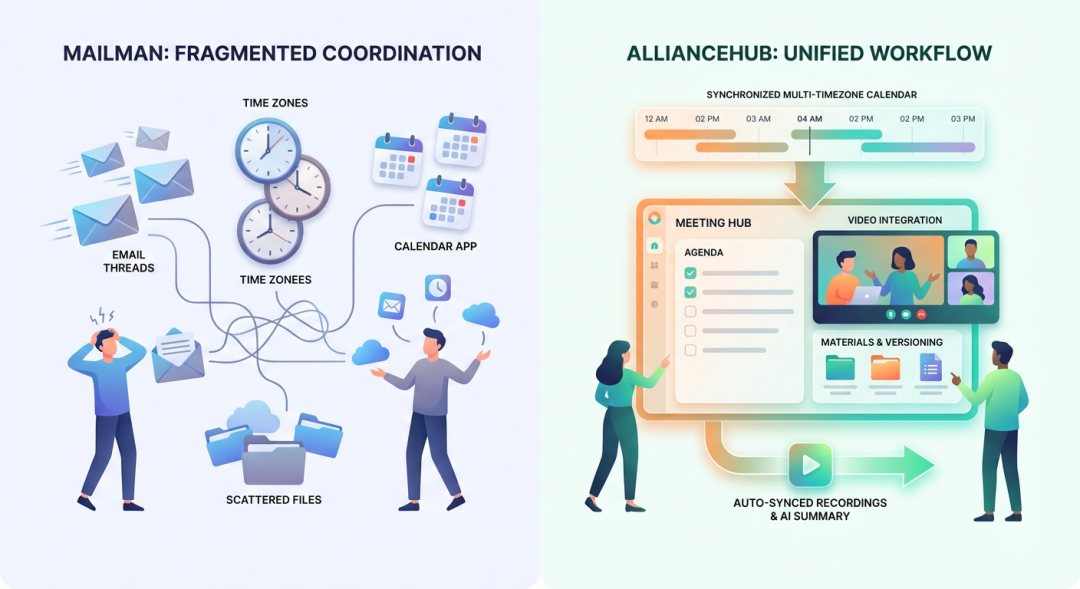
The difference: integrated meeting management versus scattered coordination.
4. From Broadcast Access to Hierarchical Organization
With Mailman: Mailman lists are flat. You subscribe or you don’t. You can post or you can’t. If your alliance has multiple working groups, regional chapters, and technical committees, you need separate lists for each. Managing who belongs where becomes a spreadsheet exercise. Cross-group collaboration requires forwarding emails between lists. Complex organizational structures cannot be modeled.
With AllianceHub: Group structures mirror real-world organization. A global alliance can create regional groups (Asia-Pacific, EMEA, Americas) with subgroups beneath them. Technical committees can exist alongside regional chapters. Members can belong to multiple groups. Group administrators manage membership locally. External experts can be invited to specific collaborations without full membership. The structure scales with organizational complexity.
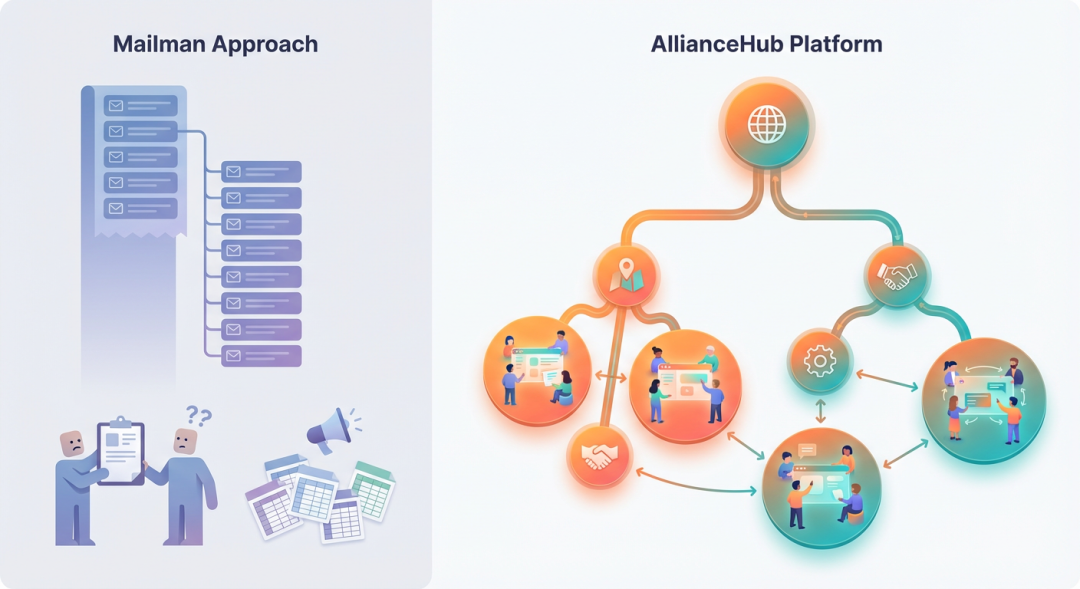
The difference: hierarchical modeling versus flat lists.
5. From Attachment Archives to Document Management
With Mailman: Documents travel as email attachments. Archives store them, but finding that specification document from six months ago means searching through email threads. Multiple versions create confusion—did you review v3 or v4? There’s no check-in/check-out, no version history, no organized folder structure. Documents live wherever members save them.
With AllianceHub: Documents are organized in hierarchical folders with clear permissions. Version control ensures everyone references the current version. Large files are handled efficiently. Batch download enables offline work. Meeting materials, proposal documents, and reference files each have their place. Members know where to find what they need.
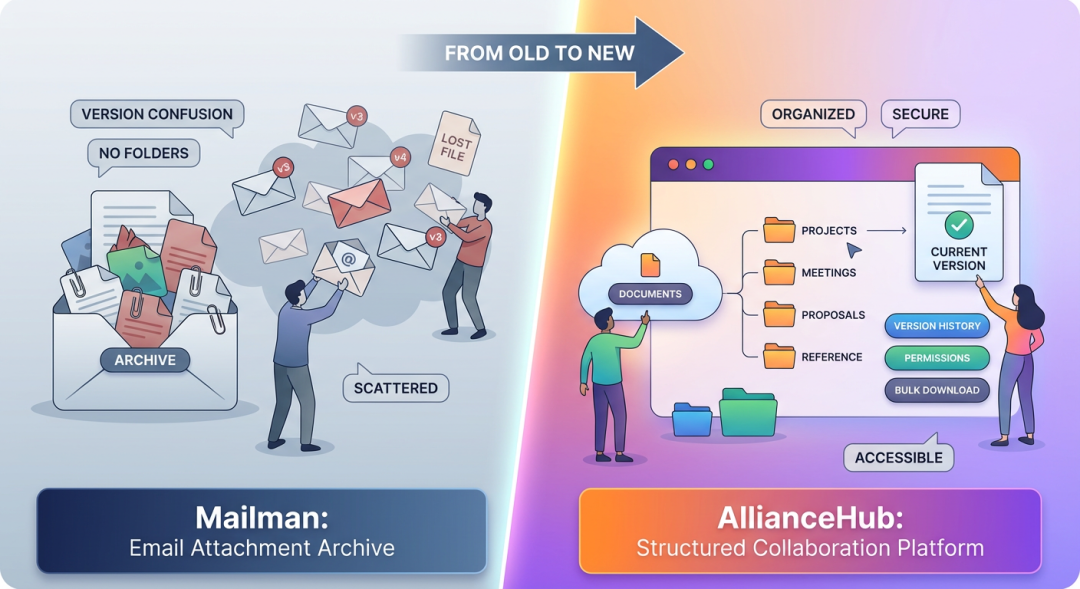
The difference: document management versus attachment storage.
6. From Admin-Heavy to Self-Service Membership
With Mailman: Joining a working group typically requires emailing an administrator who manually updates the list. The administrator maintains separate records of who’s in which group. Unsubscribing requires another email. Member status changes require manual intervention. Administrators become bottlenecks.
With AllianceHub: Members can initiate group join applications directly. Administrators review and approve through a web interface. Application status is visible throughout. Bulk operations allow adding members to multiple groups efficiently. Member-group relationships are visible at a glance. The process scales without linear administrative overhead.
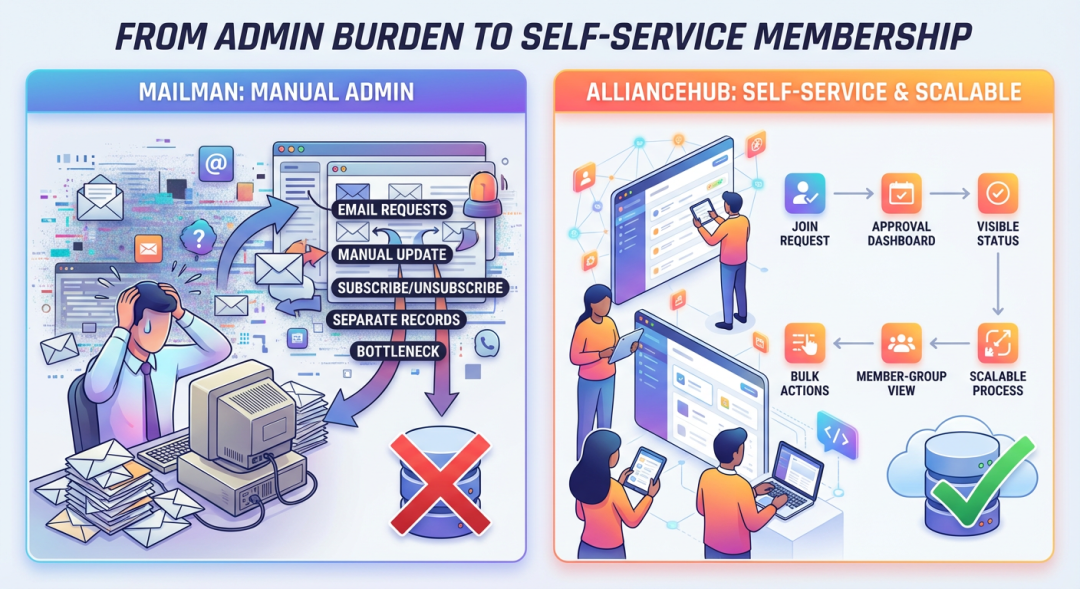
The difference: streamlined self-service versus administrative bottleneck.
7. From Text-Only to Rich Media and Mobile Access
With Mailman: Interaction is email-based—text and attachments. The web interface is for administration, not participation. Mobile access means checking email on your phone. There’s no app experience, no push notifications for specific alliance activities, no ability to review materials or vote from mobile devices.
With AllianceHub: Members can add AllianceHub to their mobile home screen for instant access. Push notifications alert members when proposals need review or ballots are open. The full platform experience—from meeting participation to proposal submission—works on mobile devices. Members traveling or working remotely remain fully engaged.
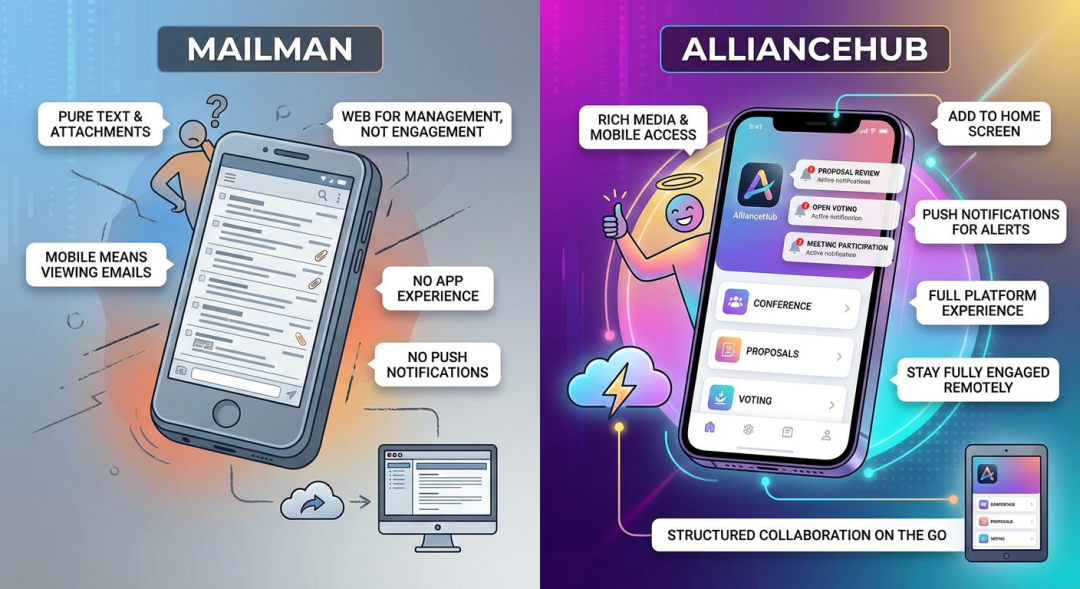
The difference: mobile-first engagement versus desktop-dependent email.
Feature Comparison: Mailman vs AllianceHub
| Capability | Mailman | AllianceHub |
|---|---|---|
| Communication | Email broadcast | Email + web + mobile |
| Meeting Management | Not supported | Integrated with Zoom/Feishu, calendar, recordings |
| Formal Voting | Informal email polls | Structured ballots, quorum enforcement, audit trails |
| Proposal Workflows | Email threads | Custom stages, similarity detection, cross-org collaboration |
| Document Management | Attachment archiving | Folder structure, version control, large file support |
| Group Structure | Flat lists | Multi-level hierarchy, subgroups, flexible membership |
| Access Control | Basic subscribe/post permissions | Role-based, granular permissions, private groups |
| Mobile Experience | Email on phone | Progressive web app, push notifications |
| Meeting Integration | None | Video conferencing, AI summaries, agenda management |
| Self-Service | Admin-mediated | Online applications, status tracking |
| Audit & Compliance | Message archives | Action logging, ballot records, proposal history |
When Mailman Still Makes Sense
Mailman remains appropriate for certain use cases:
- Communities that primarily need discussion and announcements
- Organizations with limited technical requirements
- Groups with simple, flat membership structures
- Scenarios where email-only interaction is sufficient
- Budget-constrained environments needing basic list functionality
If your organization’s needs stop at “send messages to groups of people,” Mailman delivers.
When AllianceHub Becomes Essential
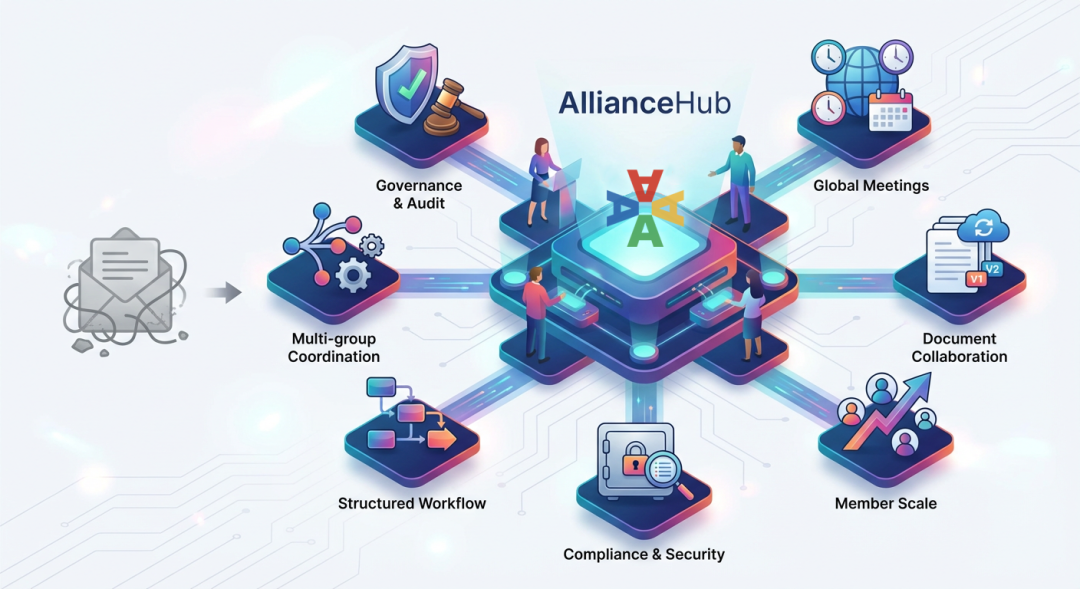 AllianceHub proves essential when your organization faces:
- Governance complexity: Formal decision-making with audit requirements
- Multi-group coordination: Working groups, committees, regional chapters
- Structured workflows: Proposals requiring review, approval, and publication
- Meeting intensity: Regular cross-timezone sessions needing coordination
- Document collaboration: Versioned materials requiring organized access
- Member scale: Growth making manual administration impractical
- Compliance needs: Record-keeping, access controls, audit trails
International alliances, standards organizations, industry consortia, and multi-stakeholder collaborations typically hit these thresholds quickly.
The Migration Path
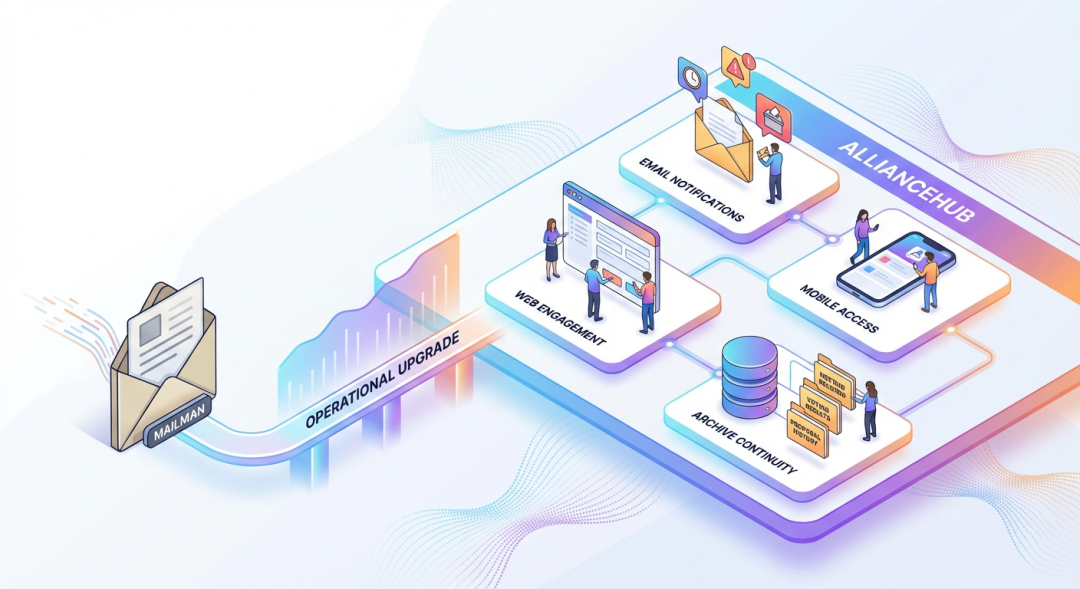 For organizations currently using Mailman or similar email list managers, transitioning to AllianceHub doesn’t require abandoning email—it enhances it. AllianceHub provides:
- Email notifications for relevant activities (proposals awaiting review, upcoming meetings, new ballots)
- Web-based participation for structured activities that email cannot support
- Mobile access for engagement on any device
- Archival continuity with meeting records, ballot results, and proposal histories
The migration isn’t just a technology change—it’s an operational upgrade from communication tools to collaboration infrastructure.
Key Benefits of Choosing AllianceHub
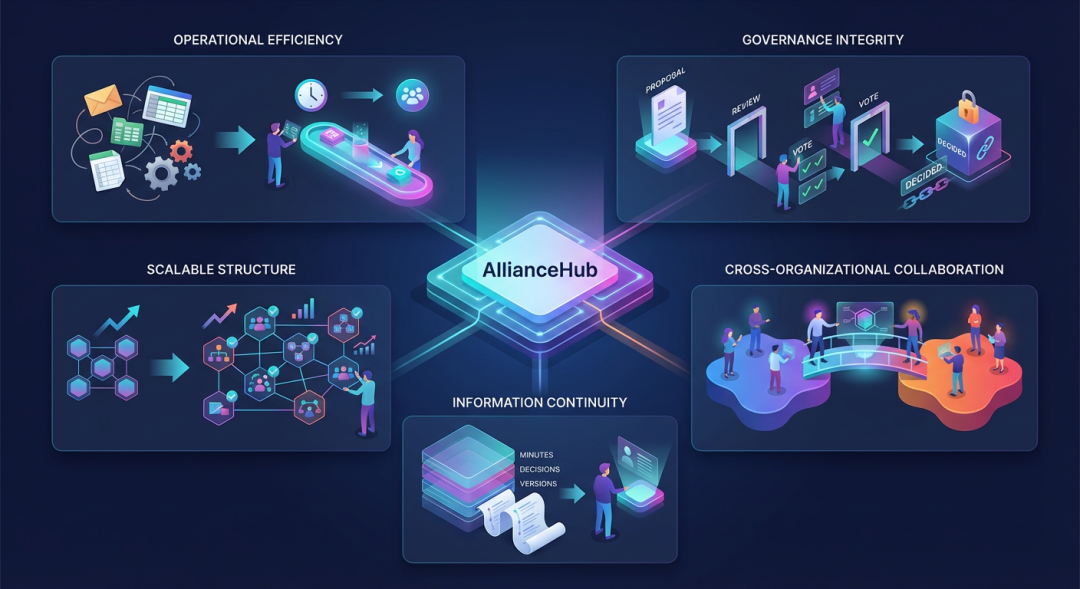
1. Operational Efficiency What required email coordination, spreadsheet tracking, and manual administration becomes automated workflow. Time spent on logistics redirects to productive collaboration.
2. Governance Integrity Decisions carry proper procedural weight with clear audit trails. Proposals advance through proper review stages. Ballots meet quorum and voting requirements.
3. Scalable Structure As membership and activity grow, AllianceHub’s structure accommodates complexity without proportional administrative burden. Groups multiply. Proposals increase. Participation expands.
4. Cross-Organizational Collaboration Experts participate regardless of formal affiliations. External members contribute to specific initiatives. Committees span organizational boundaries without structural reorganization.
5. Information Continuity Knowledge persists in the platform—meeting records, decision histories, document versions. New members access historical context. Organizational memory survives personnel transitions.
Conclusion
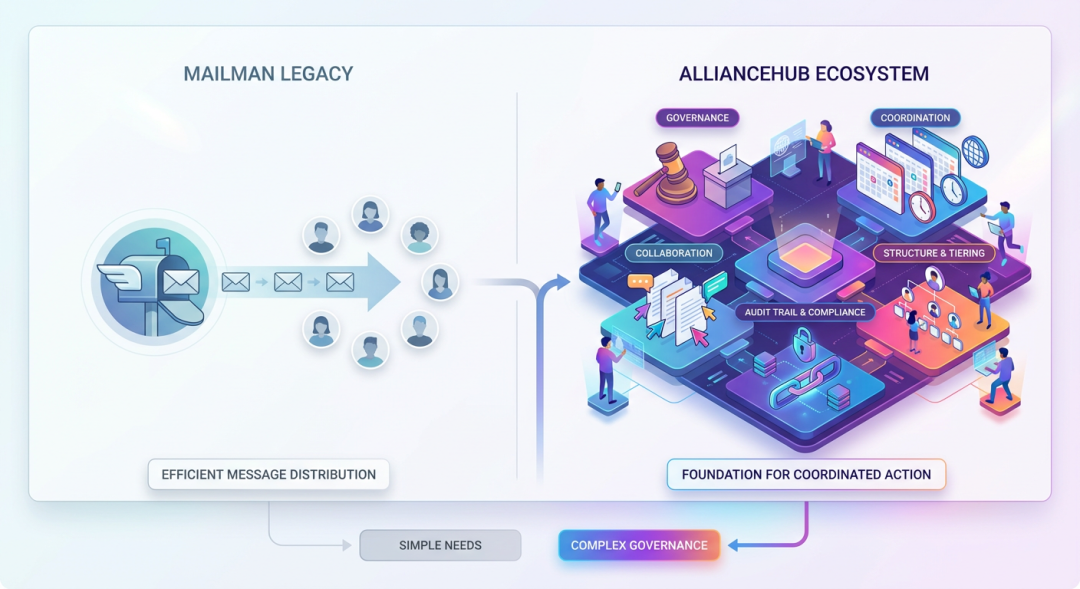
Mailman solved the problem of its era: distributing messages to groups efficiently. For alliances whose needs remain at that level, it continues to serve.
But modern international alliances operate differently. They need structured governance, coordinated meetings, formal decision-making, document collaboration, and hierarchical organization. They need members to participate across time zones and devices. They need audit trails for compliance and continuity across transitions.
AllianceHub was built for these needs—not as an email replacement, but as a collaboration foundation. Where Mailman enables communication, AllianceHub enables coordinated action.
The question isn’t which tool is better in absolute terms. The question is: what does your alliance need to accomplish? If you need to manage complex organizational workflows with governance rigor, AllianceHub provides the infrastructure that email lists simply cannot.