
Working Groups in International Alliances: Structures that Scale
International alliances are complex organisms—bringing together member organizations with different structures, cultures, and participation levels. Effective alliance management requires flexible group structures that can accommodate this diversity while maintaining clear governance and efficient collaboration.
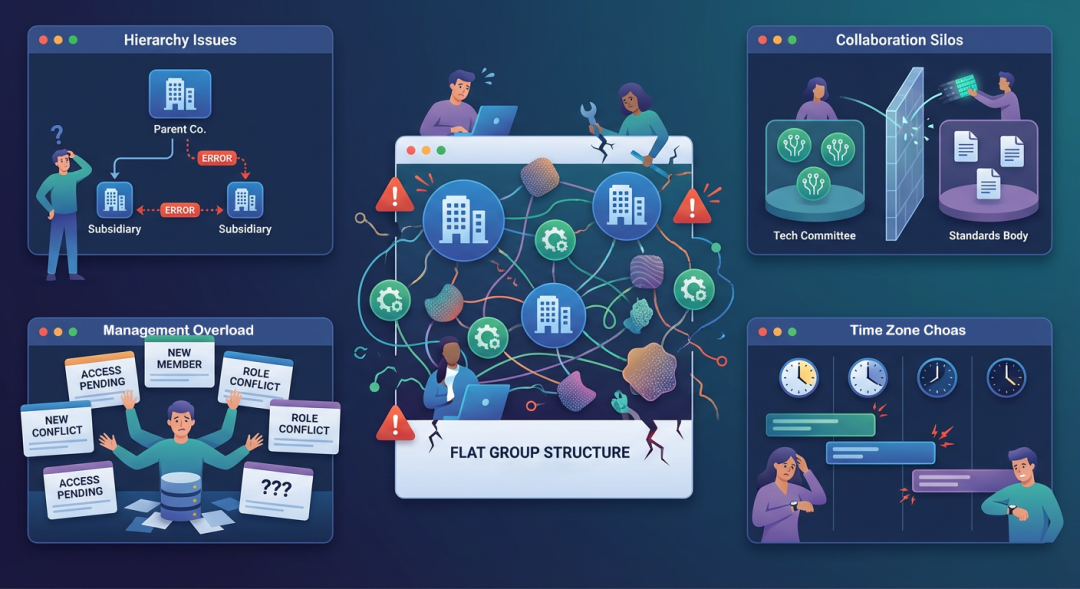
Let’s say there is an international technology alliance with member organizations ranging from large corporations to specialized research institutes. As the alliance grows, managing participation through simple, flat group structures becomes increasingly difficult. The alliance faces several structural challenges:
- Limited hierarchical modeling: One-level groups can’t represent complex organizational relationships (parent companies with subsidiaries, regional chapters with local branches)
- Cross-functional collaboration barriers: Technical committees need to work with standardization bodies, but structural boundaries make collaboration difficult
- Membership management complexity: As membership grows, tracking who belongs to which groups, managing access, and processing join applications becomes burdensome
- Schedule coordination difficulties: Different groups operate on different cycles and time zones, making alliance-wide coordination challenging
- Permission management overhead: Flat group structures force extensive individual permissions rather than efficient hierarchical controls
The Challenge: Structures That Scale with Alliance Growth
Traditional group management approaches for international alliances often rely on:
- Email distribution lists for group communications
- Spreadsheet-based membership tracking
- Manual permission assignment for each collaboration scenario
- Ad hoc coordination meetings
- Separate systems for different alliance functions
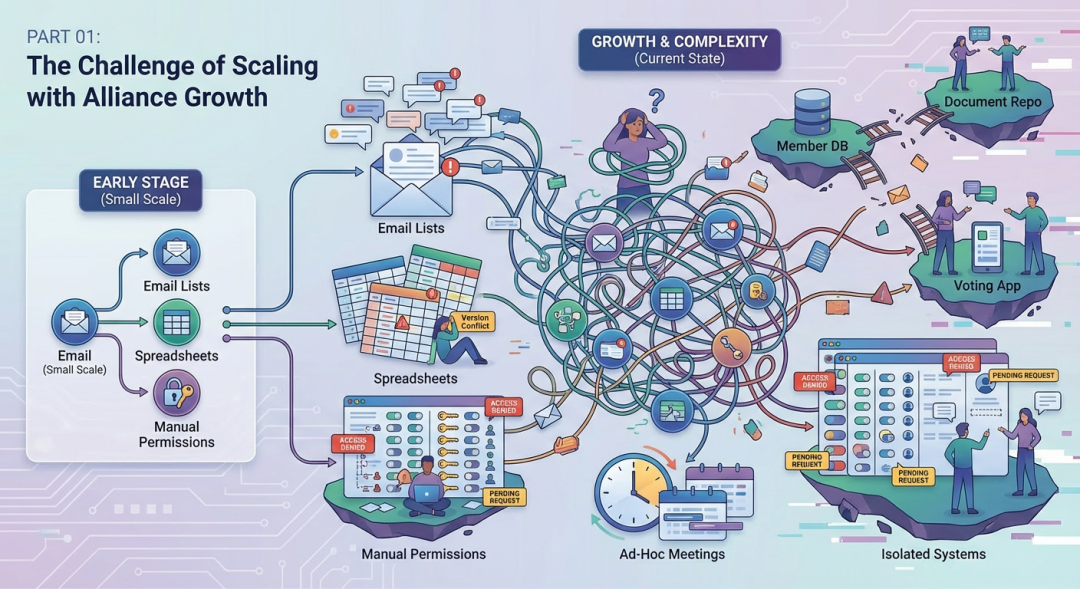
These approaches struggle with:
- Providing clear organizational structure that members intuitively understand
- Enabling efficient cross-group collaboration without administrative overhead
- Scaling gracefully as alliance membership and activities grow
- Maintaining security and governance compliance
- Supporting diverse organizational models within one platform
Solution: AllianceHub’s Flexible Group Management Framework
AllianceHub addresses these challenges by providing a comprehensive group management framework that supports complex structures while maintaining efficiency and governance.
1. Multi-Level Group Structure: Mirroring Real-World Organizations
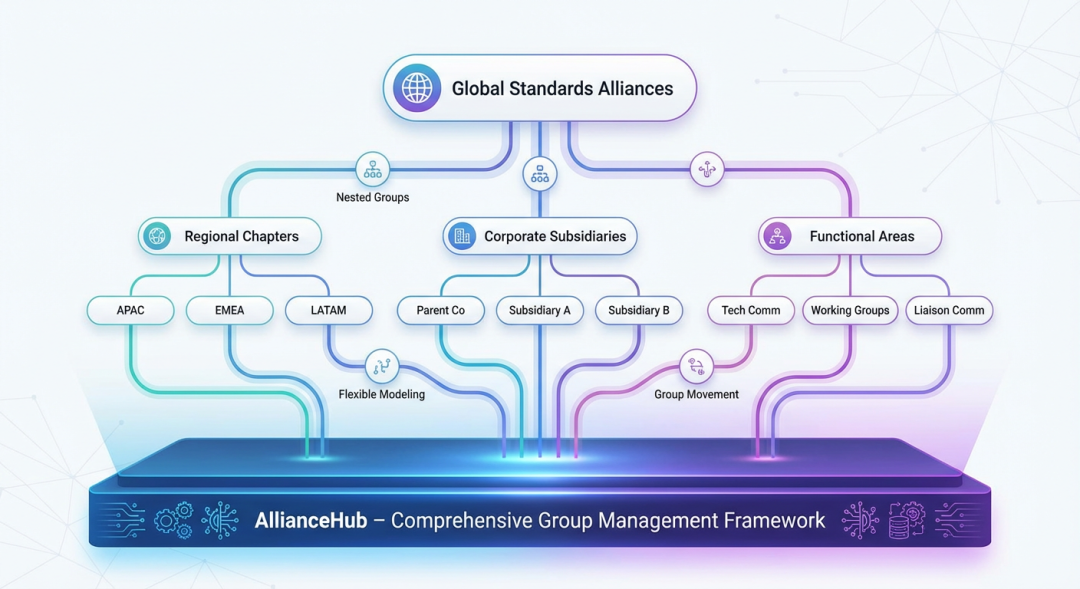
International alliances need group structures that reflect their organizational reality. AllianceHub supports hierarchical group systems:
- Subgroup creation: Groups can be created under any existing group, enabling unlimited nesting depth
- Flexible structural modeling: Build structures that mirror real-world relationships—regional alliances with local chapters, parent companies with subsidiaries, functional areas with specialized teams
- Group movement: Support for moving groups between levels, facilitating real-time structural adjustments as alliance governance evolves
This flexibility allows alliances to create group structures that make intuitive sense to their members—improving adoption and reducing navigation confusion. A global standardization alliance can structure groups by region (Asia-Pacific, EMEA, LATAM), then by functional committees (Technical Steering, Working Groups, Liaison Committees), mirroring their real organizational model.
2. Online Group Join Applications: Streamlined Membership Growth
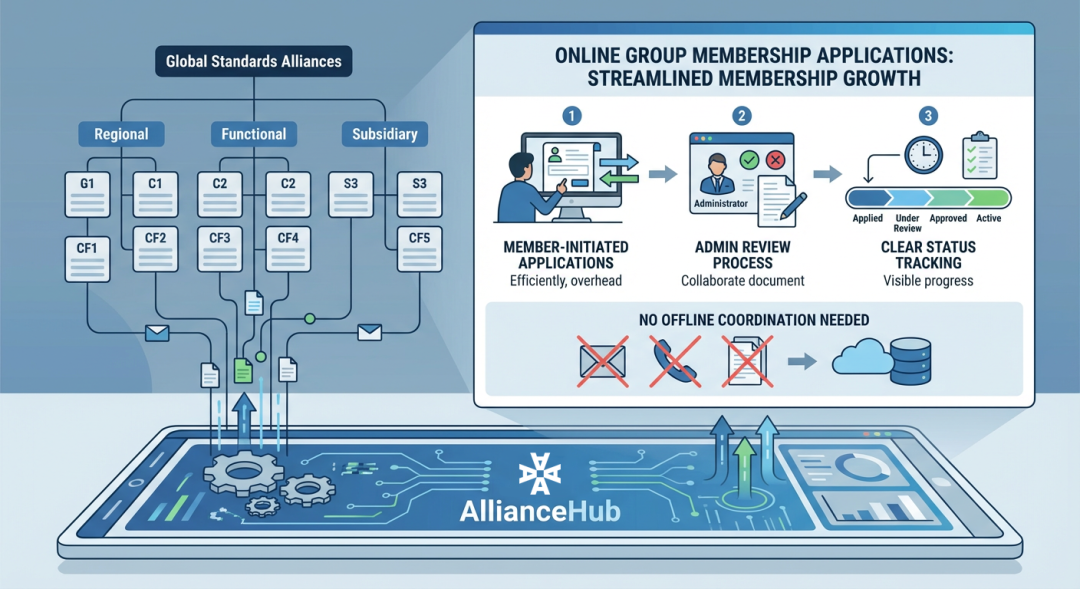
As alliances attract new member organizations, managing the onboarding process efficiently becomes critical. AllianceHub provides online application workflows:
- Member-initiated applications: Potential member organizations can initiate group join applications directly on the platform
- Admin review process: Group administrators review and process applications online, making internal collaboration flow more efficient
- Clear status tracking: Application status is visible throughout the process, reducing communication overhead
- No offline coordination: Eliminates the need for emails, phone calls, and offline paperwork for membership applications
This online-first approach significantly reduces the time and coordination overhead of bringing new members into alliance activities—streamlining the path from application to active participation.
3. Role-Based Group Management: Clear Accountability
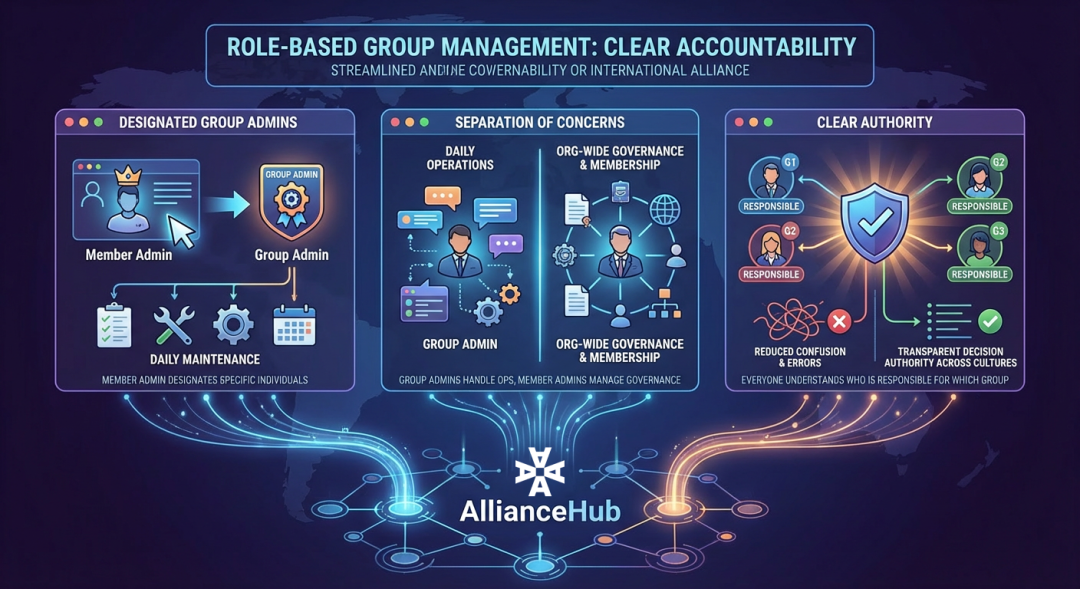
Complex alliances require clear governance structures with defined responsibilities. AllianceHub introduces role-based group management:
- Designated Group Administrators: Member administrators can designate specific individuals as Group Administrators with clearly defined responsibilities for daily group maintenance
- Separation of concerns: Group Administrators handle day-to-day operations while Member Administrators manage organization-wide membership and governance
- Clear authority: Everyone understands who is responsible for what group, reducing operational confusion and cross-role errors
This role clarity is particularly important for international alliances where decision-making authority needs to be transparent across different organizational cultures and member organizations.
4. Efficient Member-Group Management: Member-Centric Operations
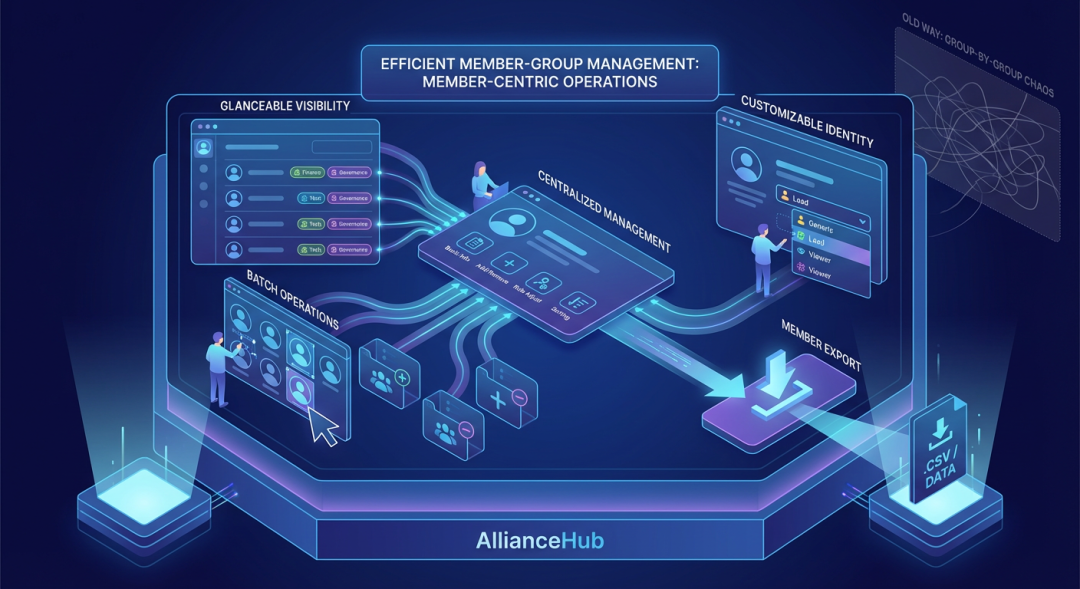
In alliances with large member populations and complex group structures, member-group relationships become challenging to manage. AllianceHub provides member-centric management capabilities:
- Group visibility at a glance: In the member list, administrators can quickly view which groups each member belongs to, making member affiliation transparent
- Bulk operations: Support for quickly adding members to multiple groups or removing them from specific groups, reducing repetitive operational costs
- Customizable member identities: Group Administrators can customize member identities according to organizational needs
- Centralized information management: Manage group basic information, member additions and removals, identity adjustments, and sorting from one interface
- Member export: One-click export of member information for convenient statistics and archiving
This transforms member management from a “group-by-group maintenance” burden into an efficient “member-centric” approach—particularly valuable when onboarding new member organizations or auditing membership across the alliance.
5. Group Calendars: Alliance-Wide Scheduling Visibility
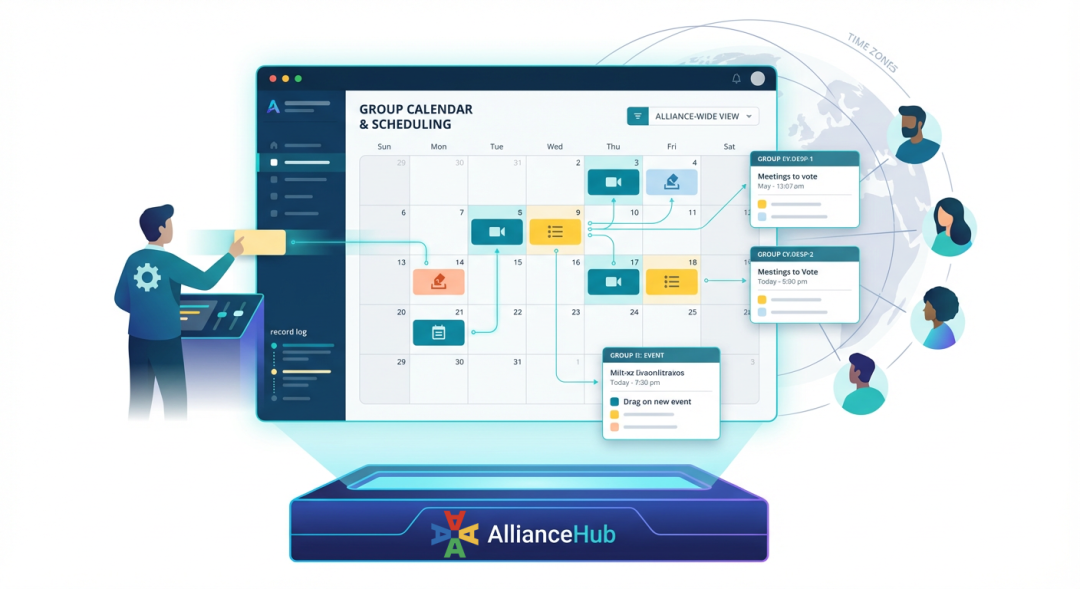
International alliances need visibility into activities across all groups for effective coordination. AllianceHub provides group-level calendars:
- Centralized group activities: Displays group-related meetings, schedules, and ballot arrangements in one view
- Monthly overview: Monthly views enable quick grasp of recent group activities, supporting managers in planning and coordination
- Schedule administrator control: Designated managers can centrally add or cancel schedules, with all operations logged
This group-level visibility helps alliance leadership understand activity patterns, identify coordination opportunities, and ensure important events reach the right groups across the alliance regardless of time zone differences.
6. Cross-Group Collaboration: Breaking Structural Boundaries
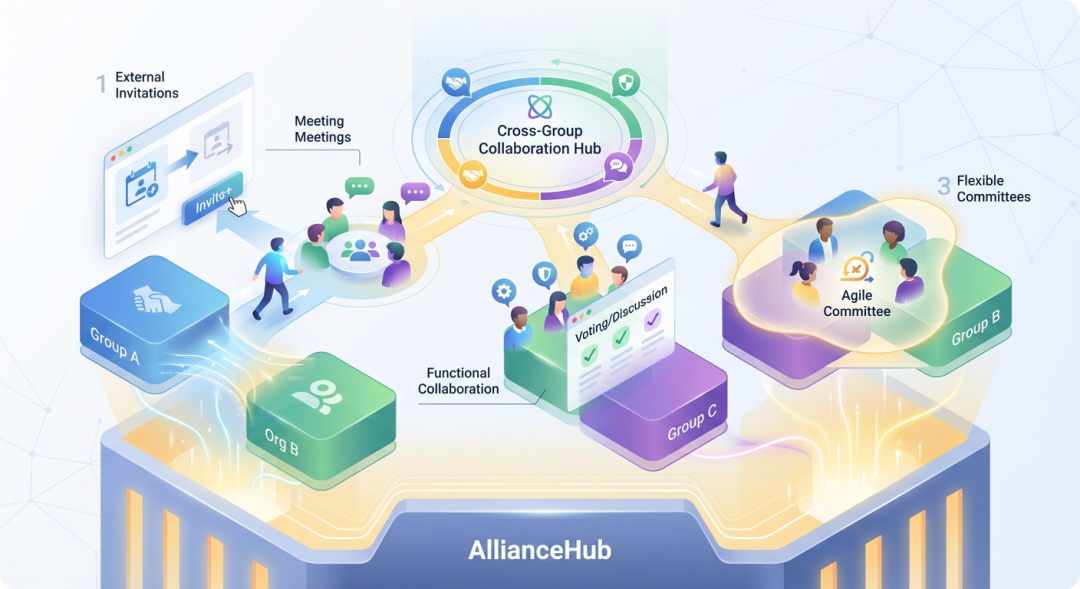
While group structures provide organization, international alliances also need flexibility for collaboration that crosses group boundaries. AllianceHub enables this through:
- External member invitation: When initiating group meetings or ballots, organizers can invite external members from other groups to participate
- Functional collaboration: Technical experts can participate in relevant votes and discussions regardless of formal group membership
- Committee flexibility: Committees can span multiple member organizations and groups without requiring redundant membership structures
This capability is essential for international alliances where expertise is distributed across member organizations. A security review panel might require participation from security experts across five different companies—AllianceHub makes this collaboration possible without requiring complex overlapping membership structures.
7. Module Visibility Control: Streamlined Group Experiences
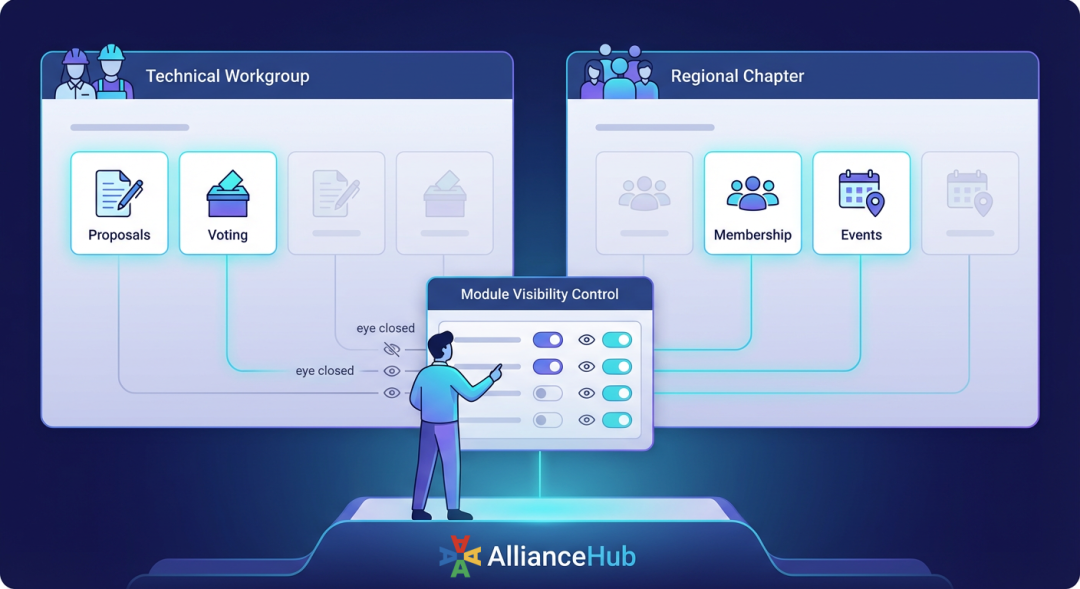
Not all groups need all alliance capabilities. Different groups have different responsibilities and workflows. AllianceHub provides module management at the group level:
- Group-specific module configuration: Administrators can configure module visibility separately for different groups
- Relevant feature exposure: Groups see only the modules relevant to their work, reducing interface complexity
- Dynamic adjustment: Module visibility can be adjusted as group responsibilities evolve
For international alliances, this means that a technical working group sees proposal and ballot modules while a regional chapter group focuses on membership and event modules—each with a streamlined interface optimized for their actual needs.
8. Private Groups: Confidential Collaboration Spaces
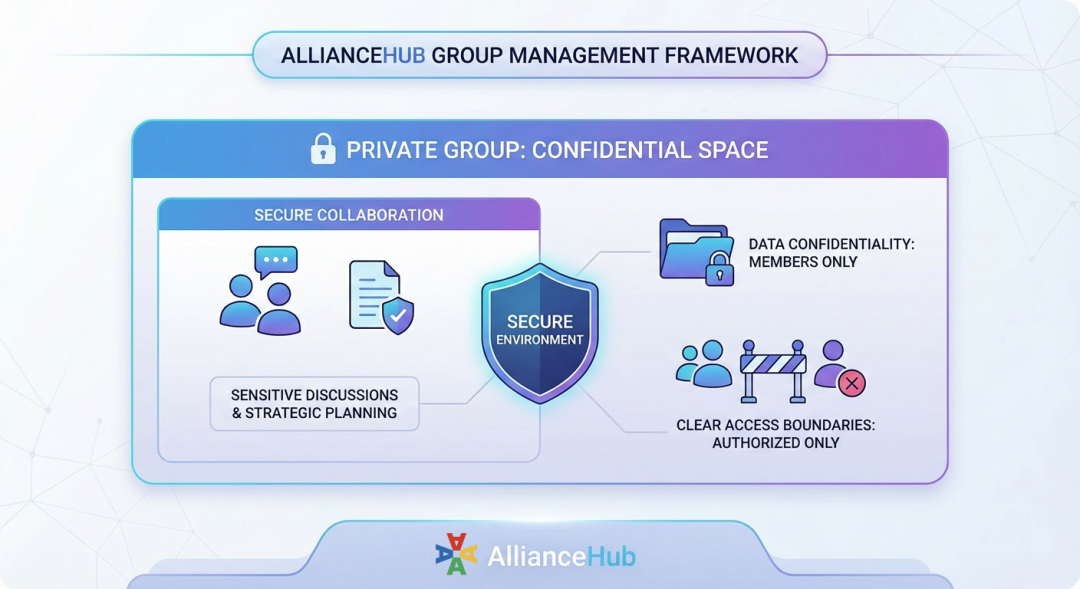
Some alliance activities require confidentiality—sensitive discussions, preliminary strategic planning, or member organization-specific coordination. AllianceHub supports private groups:
- Data confidentiality: All data within private groups is only visible to organization administrators and group members
- Secure collaboration space: Provides a protected environment for confidential discussions
- Clear access boundaries: Private group boundaries are clearly enforced, preventing accidental information sharing
For international alliances, this enables confidential coordination scenarios—such as discussing merger opportunities or addressing sensitive governance matters—in a secure space where only authorized participants have access.
9. Member Search: Efficient Information Retrieval
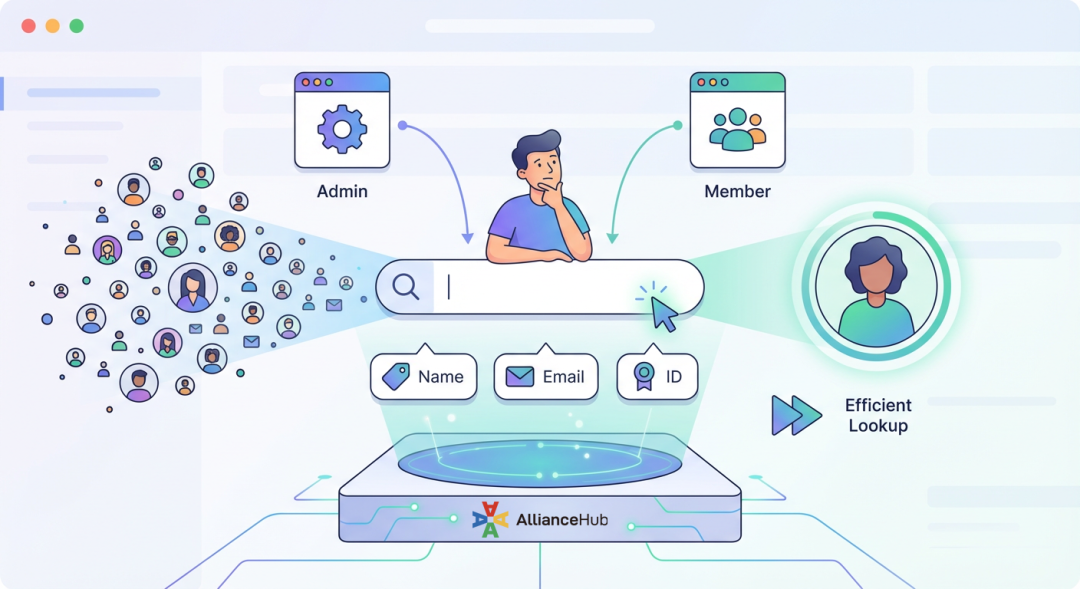
As alliance membership grows, finding specific members becomes increasingly challenging. AllianceHub provides search capabilities:
- Quick member location: Search for target members within groups by name, email, or other identifiers
- Efficient lookup: Improves administration efficiency when managing large member populations
- Multiple management entry points: Organization administrators and Member administrators can manage Group Members through multiple entry points
This search capability is essential when alliances reach hundreds of member organizations and thousands of individual participants, making member management operations practical at scale.
10. Intuitive Group Switching: Reduced Navigation Friction
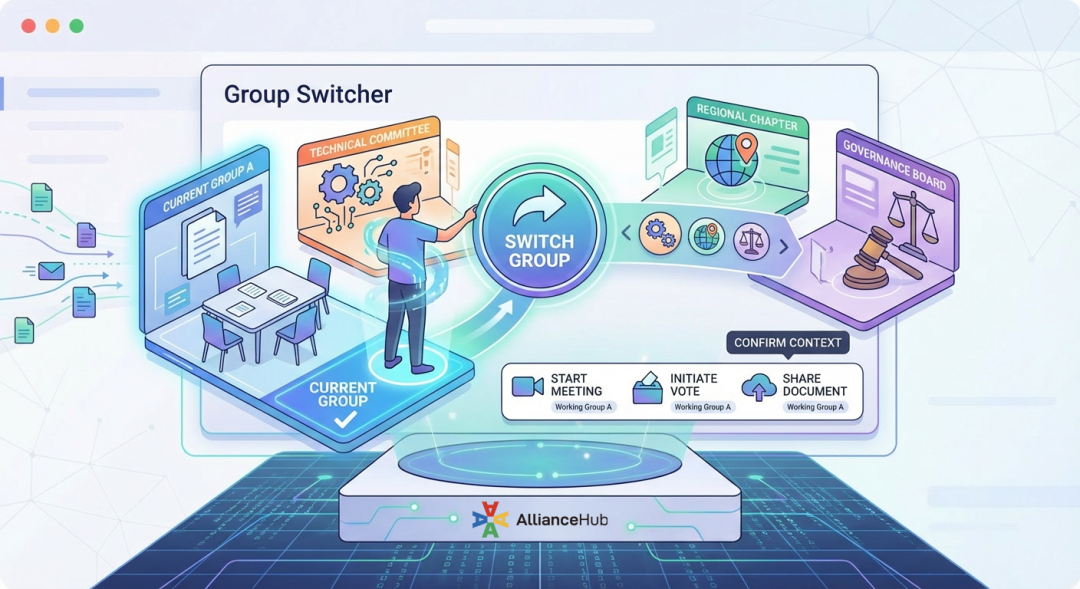
Members who participate in multiple alliance groups need efficient ways to navigate between contexts. AllianceHub optimizes group switching:
- Prominent switching access: Entry point is larger and more prominent, making operations convenient
- Clear current group identification: Users can intuitively confirm which group they’re currently in, avoiding misoperations
- User-friendly operation prompts: When initiating Meetings, Ballots, and other operations, clear prompts help users confirm hierarchy levels
For international alliance members who belong to multiple technical committees, regional chapters, and working groups, this reduces the risk of operating in the wrong group context—a critical safeguard in complex multi-group environments.
Traditional vs. AllianceHub: The Impact
| Aspect | Traditional Group Management | With AllianceHub |
|---|---|---|
| Organizational structure | Flat or ad hoc | Multi-level subgroups reflecting real org model |
| Membership onboarding | Email, phone, offline forms | Online applications with clear status tracking |
| Role clarity | Implicit, often confused | Designated Group Administrators with clear responsibilities |
| Member-group management | Spreadsheet, repetitive tasks | Member-centric operations, bulk management |
| Schedule visibility | Fragmented, hard to coordinate | Group calendars with centralized scheduling |
| Cross-Collaboration | Structural barriers | External member invitation for flexible participation |
| Interface complexity | All features visible everywhere | Module control for streamlined experiences |
| Confidentiality | Limited or ad hoc | Private groups with enforced access control |
| Search efficiency | Manual scanning at scale | Quick member search across groups |
| Navigation safety | Easy to misoperate | Clear group identification and prompts |
Key Benefits for International Alliances
1. Scalable Organizational Modeling
- Multi-level group structures mirror real-world alliance organization
- Flexible hierarchy creation and adjustment as alliance evolves
- Intuitive navigation improves member adoption
2. Efficient Membership Management
- Online applications streamline onboarding
- Member-centric operations reduce administrative overhead
- Search capabilities make large-scale management practical
3. Cross-Group Collaboration Without Overhead
- External member invitation enables expertise-based participation
- Functional collaboration without complex membership structures
- Committees can span multiple organizations seamlessly
4. Governance and Security
- Role-based management with clear accountability
- Private groups for confidential collaboration
- Module-level access control for appropriate information exposure
5. Streamlined User Experience
- Relevant features per group reduce interface complexity
- Intuitive navigation prevents operational errors
- Group calendars improve visibility and coordination
Conclusion
International alliances succeed when their organizational structures enable—rather than hinder—collaboration. Structures that are too rigid can’t accommodate alliance diversity, while structures that are too flexible lack the clarity needed for effective governance.
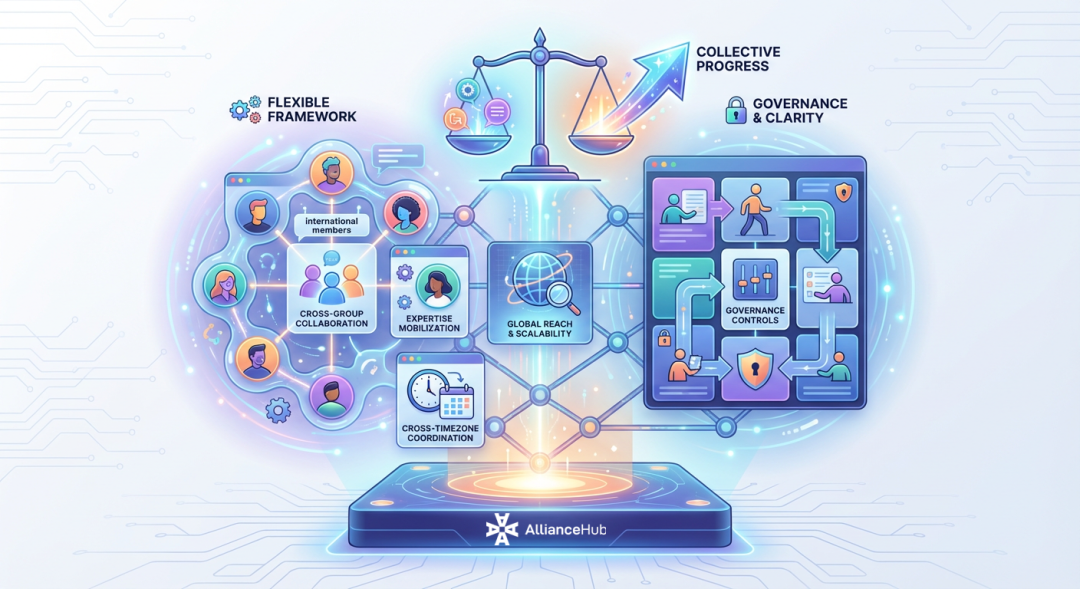
AllianceHub provides the balance: group management frameworks flexible enough to model complex international alliance organizations while maintaining the clarity, security, and efficiency needed for productive collaboration. Through multi-level structures, member-centric management, cross-group collaboration capabilities, and governance controls, alliances can build organizational foundations that scale with their growth.
The result is international alliances where group structures support—rather than constrain—their ability to mobilize expertise across member organizations, coordinate activities across time zones, and maintain the governance foundations essential for collective progress.